Free Shipping on Orders Over $99*

Price range: US$61.94 through US$115.50
This product has multiple variants. The options may be chosen on the product page
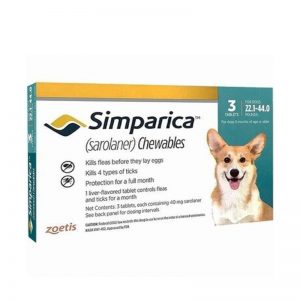
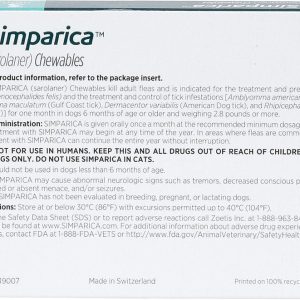
Price range: US$60.65 through US$111.75
This product has multiple variants. The options may be chosen on the product page
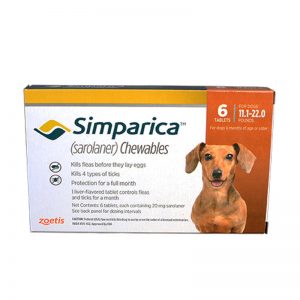
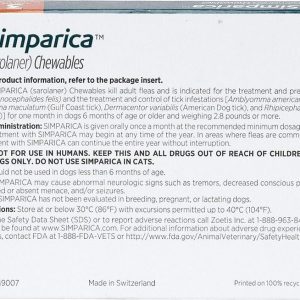
Price range: US$54.50 through US$98.85
This product has multiple variants. The options may be chosen on the product page
Price range: US$79.55 through US$131.40
This product has multiple variants. The options may be chosen on the product page
Price range: US$53.60 through US$97.70
This product has multiple variants. The options may be chosen on the product page
Price range: US$53.50 through US$97.50
This product has multiple variants. The options may be chosen on the product page
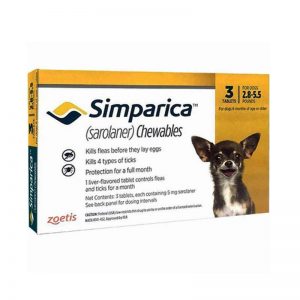
Simparica is an oral isoxazoline chewable tablet manufactured by Zoetis, using sarolaner to kill fleas and ticks systemically for up to 35 days per dose. It covers six tick species and is approved for dogs 6 months of age and older weighing at least 2.8 lbs (1.27 kg).
Anipetshop is licensed under Australian APVMA regulations and ships Simparica directly from Australia without a prescription requirement. The formulation, active ingredient concentration, and dosage are identical to those dispensed at U.S. veterinary clinics.
Can You Buy Simparica Without a Vet Prescription?
Yes, Simparica can be ordered without providing a vet prescription through Anipetshop sourced directly from approved manufacturers. Whether a prescription is required depends on the country of sale, not the country of delivery.
In the United States, the FDA classifies Simparica as a prescription-only veterinary medication under the Federal Food, Drug, and Cosmetic Act. U.S.-licensed retailers must obtain veterinary authorization before dispensing sarolaner-based treatments.
The classification falls under a separate system in Australia, where the APVMA applies a different regulatory regime to the same compound. As a result, pharmacies licensed under this framework may dispense Simparica without requiring an individual prescription from the customer.
As an Australian-licensed pharmacy, Anipetshop supplies Simparica as an over-the-counter product in line with APVMA regulations. The product formulation, active ingredient concentration, and dosage standards are identical to those supplied to veterinary clinics in the United States.
Explore the Simparica Chewable Tablet Formulation
Simparica is an oral isoxazoline tablet delivering sarolaner systemically to kill fleas and ticks for up to 35 days per dose. Each tablet is liver-flavored using pork liver powder, which supports voluntary ingestion in most dogs without requiring the tablet to be concealed in food. The formulation details relevant to storage and identification are as follows:
- Flavoring: Pork liver powder is used as the flavoring base, supporting voluntary ingestion in most dogs without concealing the tablet in food.
- Key Excipients: Contains sarolaner as the active compound, with lactose monohydrate, maize starch, sodium starch glycolate, magnesium stearate, silica, and wheat germ as inactive ingredients.
- Physical Form: Mottled brown, square-shaped tablets with rounded edges, embossed with a number indicating milligram strength.
- Storage: Store in original packaging below 86°F (30°C), away from light and moisture, and out of reach of children.
Simparica is available in six packs. Select the pack that corresponds to your dog’s current body weight:
| Product | Price for 3 Chews | Price for 6 Chews | Pack Color |
| Simparica For Dogs 2.8–5.5 lbs (1.3–2.5 kg) | $53.50 | $97.50 | Yellow |
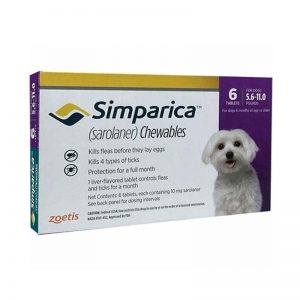
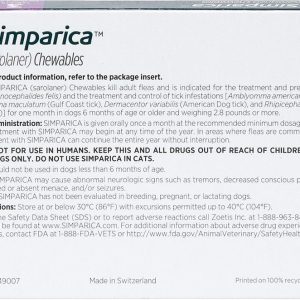
| Simparica For Dogs 5.6–11 lbs (2.6–5 kg) | $53.60 | $97.70 | Purple |
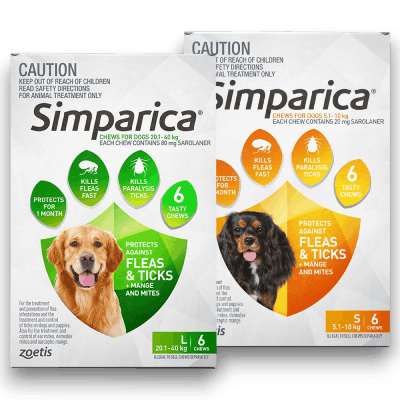
| Simparica For Dogs 11.1–22 lbs (5.1–10 kg) | $54.50 | $98.85 | Orange |
| Simparica For Dogs 22.1–44 lbs (10.1–20 kg) | $60.65 | $111.75 | Blue |
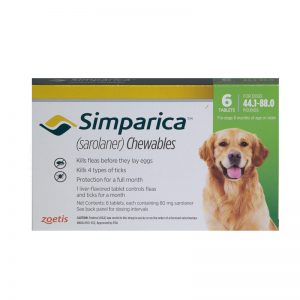
| Simparica For Dogs 44.1–88 lbs (20.1–40 kg) | $61.94 | $115.50 | Green |
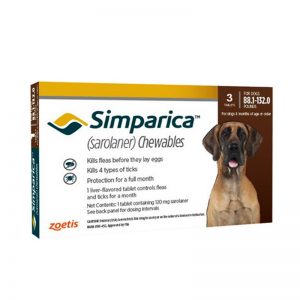
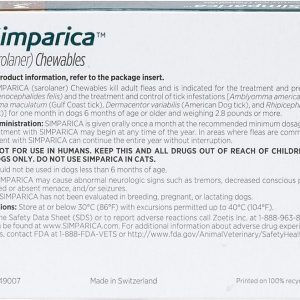
| Simparica For Dogs 88.1–132 lbs (40.1–60 kg) | $79.55 | $131.40 | Brown |
Take the Correct Dosage
Simparica dosing is based strictly on your dog’s current body weight, with six tablet strengths ranging from 5 mg to 120 mg, covering dogs from 2.8 lbs (1.27 kg) to 132 lbs (59.87 kg). Dosage selection depends on weight alone, not breed or age beyond the minimum of 6 months.
Each weight range corresponds to a specific tablet strength. The pack colors below match those listed in the formulation table above:
| Dog’s Weight | Tablet Strength | Pack Color |
| 2.8–5.5 lbs (1.3–2.5 kg) | 5 mg | Yellow |
| 5.6–11.0 lbs (2.6–5 kg) | 10 mg | Purple |
| 11.1–22.0 lbs (5.1–10 kg) | 20 mg | Orange |
| 22.1–44.0 lbs (10.1–20 kg) | 40 mg | Blue |
| 44.1–88.0 lbs (20.1–40 kg) | 80 mg | Green |
| 88.1–132.0 lbs (40.1–60 kg) | 120 mg | Brown |
Dogs over 132 lbs (59.87 kg) fall outside the labeled dosing range. No single tablet covers this weight, and combining tablets should only be done under veterinary supervision.
If your dog’s weight falls at the upper boundary of a range, select the higher strength rather than remaining in the lower one. A dog at exactly 22 lbs dosed with the 20 mg tablet is at the labeled ceiling of that strength, where plasma sarolaner levels may not sustain full efficacy through day 35. For growing puppies, size up if weight gain is expected before the next monthly dose, as a correctly dosed tablet at administration can become under-dosed within weeks.
If your dog’s weight places them within 0.5 lbs of a range cutoff, weigh them at a veterinary clinic before selecting a pack. Home scales lack the calibration needed to distinguish between adjacent tablet strengths, and an incorrect selection in either direction affects plasma sarolaner levels across the full 35-day interval.
Why Should Dog Owners Choose Simparica?
Simparica is an isoxazoline-class oral treatment that maintains effective sarolaner plasma concentrations for up to 35 days from a single dose. It kills fleas within 3 hours and six tick species within 8 hours, covering the full interval between monthly administrations without a gap in coverage.
The clinical profile that makes Simparica appropriate for most adult dogs and puppies from 6 months includes:
- Fleas begin dying within 3 hours: Sarolaner kills Ctenocephalides felis by blocking GABA-gated chloride channels in the parasite’s nervous system, reaching near-complete elimination within 8 hours of the first dose.
- Six tick species controlled within 8 hours: Coverage includes black-legged ticks, American dog ticks, Gulf Coast ticks, Lone Star ticks, brown dog ticks, and Asian longhorn ticks from the first dose onward.
- 35-day efficacy window exceeds the standard monthly cycle: A single dose maintains effective sarolaner plasma concentrations beyond 30 days, reducing the risk of a protection gap if administration is delayed by a few days.
- Approved for dogs from 6 months of age: Simparica is not approved for puppies under 6 months regardless of weight. Dogs weighing less than 2.8 lbs (1.27 kg) also fall outside the labeled dosing range.
How Do Pet Owners Review Non-Prescription Simparica Online?
User-reported outcomes for Simparica are consistent with the product’s clinical profile. On Reddit, one owner documented their experience giving Simparica to a 7 to 8-year-old stray dog weighing 18 kg (39.7 lbs), which falls within the 80 mg tablet range.
The dog initially required the tablet to be mixed with chicken for acceptance. Within one week, the owner observed a measurable reduction in flea activity and improvement in skin condition, consistent with sarolaner’s known onset: effective plasma concentrations are reached within hours of a single oral dose and maintained for up to 35 days.
Skin improvement following flea reduction is expected in dogs with flea allergy dermatitis, where the allergic response is driven by continued flea exposure rather than a primary skin condition. If your dog shows persistent skin issues after flea load is reduced, consult a veterinarian to assess whether an underlying dermatological condition requires separate treatment.
Why Order Simparica for Dogs Without a Vet Prescription at AnipetShop?
Anipetshop is licensed under Australian APVMA regulations and sources Simparica directly from the original manufacturer, Zoetis. The product supplied is identical in formulation, active ingredient concentration, and dosage to what veterinary clinics in the U.S. dispense under prescription.
The sourcing and supply conditions relevant to product integrity are as follows:
- Original manufacturer sourcing: Simparica is sourced directly from Zoetis-authorized channels across Australia and Europe. No generic or substituted formulations are stocked.
- English labeling on all packs: Every pack includes full English-language labeling covering dosage, contraindications, and storage instructions, consistent with the labeled product in the U.S. market.
- Stock rotation for shelf life: Inventory is managed to ensure each pack carries sufficient remaining shelf life for full 35-day efficacy at the time of use.
- APVMA-compliant dispensing: Anipetshop dispenses under Australian pharmacy regulations, which permit sale without an individual prescription for products classified as non-prescription under APVMA standards.
How Does Simparica Work on Dogs?
Sarolaner, the active compound in Simparica, is absorbed from the gastrointestinal tract following oral administration and distributed systemically via circulation. Parasites are exposed to the compound when they bite and ingest blood, not through contact with the skin or coat.
Sarolaner kills fleas and ticks by blocking GABA-gated chloride channels in the parasite’s nervous system. This disrupts normal inhibitory nerve signaling, causing uncontrolled neuronal activity, paralysis, and death. The compound has low binding affinity for mammalian GABA receptors, which accounts for its tolerability in dogs at labeled doses.
The clinical kill timeline and coverage across the 35-day dosing interval are as follows:
- Fleas begin dying within 3 hours: Near-complete elimination of Ctenocephalides felis is reached within 8 hours of the first dose, before a flea can complete a full feeding cycle.
- Six tick species controlled within 8 hours: Sarolaner plasma concentrations reach lethal levels for black-legged ticks, American dog ticks, Gulf Coast ticks, Lone Star ticks, brown dog ticks, and Asian longhorn ticks within 8 hours.
- Efficacy sustained for 35 days: Sarolaner’s plasma half-life maintains parasiticidal concentrations through the full dosing interval, with no reported drop in efficacy between doses when administered on schedule.
How Should You Administer Simparica?
Simparica is given orally once a month, with one tablet selected to match your dog’s current body weight. The pork liver powder flavoring supports voluntary ingestion in most dogs, though individual acceptance varies.
The following steps apply to each monthly administration:
- Offer by hand, with food, or place directly in the mouth: All three methods deliver the full dose. If your dog refuses the tablet alone, mixing it with a small amount of food is acceptable without affecting absorption.
- Administer with food if vomiting occurs: Simparica can be given with or without food under normal conditions. If your dog vomits after a fasted dose, administer subsequent doses with a meal to reduce gastric irritation.
- Confirm the full tablet is swallowed: Observe your dog until the tablet is fully ingested. Do not split or crush the tablet, as this may result in an incomplete or uneven dose.
- Administer on the same date each month: Consistent timing maintains sarolaner plasma concentrations within the therapeutic range across the 35-day interval.
If a dose is missed, administer it as soon as you notice. For example, if your dog’s regular dose date is the 1st and you miss it until the 10th, give the dose on the 10th and schedule the next dose for the 10th of the following month. Do not double dose.
Are There Any Side Effects of Simparica to Consider?
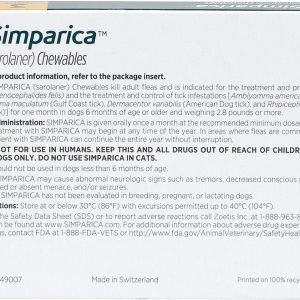
Yes, Simparica may cause gastrointestinal side effects and, in rare cases, neurological reactions. The FDA’s isoxazoline class labeling requirement, introduced in 2018, mandates that all sarolaner-based products carry warnings for neurological adverse events including tremors, ataxia, and seizures.
Gastrointestinal effects reported in clinical studies include:
- Vomiting: The most commonly reported adverse effect in sarolaner trials. Administering with food reduces occurrence in dogs with gastric sensitivity.
- Diarrhea: Reported at low frequency in clinical studies. Persistent diarrhea beyond 24 to 48 hours warrants veterinary assessment.
- Reduced appetite: Transient and typically resolves without intervention within one to two days.
- Lethargy: Reported infrequently. If lethargy persists beyond 48 hours or is accompanied by other signs, consult a veterinarian.
Neurological effects are rare but require immediate veterinary attention if observed:
- Muscle tremors: An isoxazoline class effect resulting from disruption of GABA-gated chloride channel activity. Discontinue use and contact a veterinarian immediately.
- Ataxia: Loss of motor coordination indicating central nervous system involvement. Do not administer further doses until a veterinarian has assessed the dog.
- Seizures: Dogs with a prior history of seizures or neurological disorders should not receive Simparica without prior veterinary clearance, regardless of seizure frequency or severity.
Simparica has not been evaluated for use in pregnant, breeding, or lactating dogs. Do not use in these populations without veterinary supervision. Contact a veterinarian immediately if neurological signs appear or overdose is suspected.
Are There Simparica Alternatives That Don’t Require a Vet’s Prescription?
Yes, several flea and tick treatments are available through Anipetshop without a prescription. Each differs from Simparica in delivery mechanism, active compounds, and duration, which affects suitability depending on your dog’s health history and exposure risk. Consult a veterinarian if you are unsure which treatment class is appropriate for your dog.
Products available without prescription through Anipetshop that cover flea and tick control include:
- NexGard: An oral isoxazoline chewable using afoxolaner, killing fleas within 4 hours and ticks within 24 hours, with a 30-day dosing interval. Not approved for dogs with a history of seizures without prior veterinary clearance.
- Bravecto: An oral isoxazoline chewable using fluralaner, with a single dose covering 12 weeks for fleas and most tick species. Not approved for dogs with a history of seizures without prior veterinary clearance.
- Frontline Plus: A monthly topical using fipronil and (S)-methoprene, killing adult fleas, ticks, and chewing lice while disrupting flea egg and larval development. Does not provide systemic coverage.
- Seresto Collar: A collar delivering imidacloprid and flumethrin transdermally for up to 8 months. Provides continuous low-dose exposure rather than monthly peak-and-trough plasma concentrations.
- K9 Advantix II: A monthly topical using imidacloprid, permethrin, and pyriproxyfen that kills and repels fleas, ticks, and mosquitoes. Permethrin is toxic to cats; do not use it on dogs in households with cats unless contact can be fully prevented.
FAQs
Can Dogs Take Simparica Without Food?
Yes, Simparica can be administered with or without food. If your dog vomits after a fasted dose, administer subsequent doses with a small meal to reduce gastric irritation.
How Often Do You Give Simparica?
Simparica is administered once every 30 days. Give each dose on the same date each month to maintain sarolaner plasma concentrations within the therapeutic range across the full dosing interval.
How Long Does Simparica Protection Last?
Simparica maintains parasiticidal efficacy for up to 35 days per dose against fleas and six tick species. The 35-day window provides a buffer of approximately five days beyond the standard 30-day cycle if a dose is delayed.
Can I Use Simparica on My Puppy?
Simparica is approved for puppies 6 months of age and older weighing at least 2.8 lbs (1.27 kg). Do not administer to puppies under 6 months or below the minimum weight threshold, regardless of breed size.
How Long Should My Dog Be on Simparica?
Year-round monthly dosing is the standard approach for dogs in regions with persistent flea and tick pressure. Seasonal dosing may be appropriate in some climates, but the correct duration depends on your location and your dog’s individual health history. Consult a veterinarian for a dosing schedule specific to your dog.
Do Vets Recommend Simparica?
Simparica is FDA-approved and manufactured by Zoetis. It is used in veterinary practice as a monthly oral flea and tick treatment, with a documented kill onset of 3 hours for fleas and 8 hours for six tick species. Veterinarians prescribe it routinely for dogs without contraindications to isoxazoline-class medications.
What Dogs Should Not Take Simparica?
Simparica is contraindicated in dogs with known hypersensitivity to sarolaner or other isoxazoline compounds. Dogs with a history of seizures or neurological disorders should not receive Simparica without prior veterinary clearance. Do not use in puppies under 6 months, dogs weighing less than 2.8 lbs (1.27 kg), or dogs that are pregnant, breeding, or lactating without veterinary supervision.
How Does Simparica Compare to Other Flea and Tick Treatments Available at Anipetshop?
Simparica, NexGard, and Bravecto are all oral isoxazoline treatments, but they differ in active compound, dosing interval, and tick species coverage. Frontline Plus and K9 Advantix II are topical treatments that act on contact rather than systemically, and do not require a flea or tick to bite to be effective. Seresto delivers continuous low-dose transdermal exposure over up to 8 months, suited to dogs where monthly oral dosing is impractical. The appropriate choice depends on your dog’s health history, household composition, and regional parasite pressure.