Free Shipping on Orders Over $99*

Price range: US$52.10 through US$173.30
This product has multiple variants. The options may be chosen on the product page

Price range: US$52.50 through US$168.50
This product has multiple variants. The options may be chosen on the product page
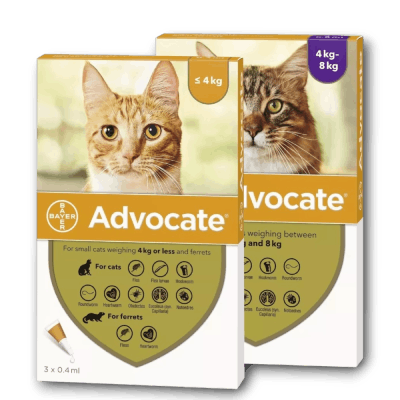
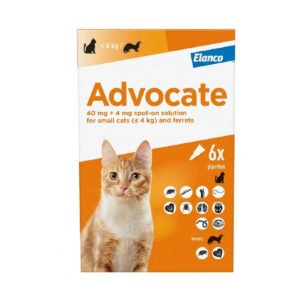
Advocate for cats is a monthly topical spot-on manufactured by Elanco, formulated with two active ingredients: imidacloprid (10 mg/kg) and moxidectin (1.0 mg/kg). This collection comprises two weight-based pipette sizes, one for cats and kittens under 4 kg (under 9 lbs) and one for cats between 4 kg and 8 kg (9 to 18 lbs). Both pipette sizes carry identical active ingredient concentrations to Advocate products available in prescription-requiring markets, including the United States.
Anipetshop supplies Advocate under Australian APVMA regulations, which classify this imidacloprid/moxidectin combination as an over-the-counter veterinary product, removing the prescription requirement at the point of purchase.
Can You Buy Advocate for Cats Without a Vet Prescription?
Advocate for cats is available at Anipetshop without a vet prescription, operating under the Australian Pesticides and Veterinary Medicines Authority (APVMA). Whether a veterinary medication requires a prescription depends on how the regulatory authority of a given country schedules it, based on the active ingredient class, safety margin at labeled doses, and the risk profile of improper administration. Two countries can evaluate the same formulation and reach different conclusions.
In the United States, the FDA Center for Veterinary Medicine classifies Advocate (marketed as Advantage Multi) as prescription-only. The FDA requires veterinary authorization because moxidectin-containing parasiticides carry a risk of adverse reaction in cats with existing adult heartworm infections, making pre-treatment screening a clinical requirement before dispensing.
Australia’s APVMA schedules the same imidacloprid/moxidectin topical combination as an over-the-counter product, dispensable without a prescription. The APVMA’s assessment concludes that the formulation’s safety margin and labeled application method do not require mandatory veterinary oversight at the point of sale.
Anipetshop, operating under APVMA jurisdiction, legally supplies Advocate without a prescription requirement. The formulation supplied contains 10 mg/kg imidacloprid and 1.0 mg/kg moxidectin, identical in active ingredient identity, concentration, and dosing standards to the prescription-required Advantage Multi sold in the U.S.
Explore the Topical Solution Formulation
Advocate for cats is supplied in two pipette sizes, differentiated by body weight and identified by pack color. Each pipette delivers imidacloprid (10 mg/kg) and moxidectin (1.0 mg/kg) via direct skin absorption at the base of the neck, providing coverage against fleas, heartworm larvae, roundworms, hookworms, lungworm, and ear mites for 4 weeks per application. The following specifications apply to both pipette sizes.
- Flavoring: Advocate is a topical formulation; the benzyl alcohol content produces a bitter taste that discourages licking of the application site.
- Key Excipients: Benzyl alcohol at greater than 50% w/w, functioning as the primary solvent carrier.
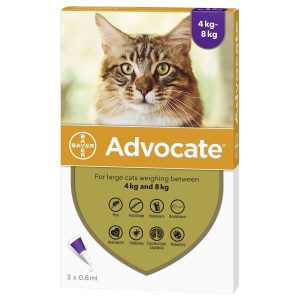
- Physical Form: Clear to pale yellow solution in a single-use pipette. The orange-coded pipette is for cats and kittens under 4 kg; the purple-coded pipette is for cats 4 to 8 kg.
- Storage: Store at or below 30°C (86°F) in a cool, dry location, out of reach of children.
The table below lists available pack sizes and current pricing for each formulation.
|
Product |
Price for 3 Doses | Price for 6 Doses | Price for 12 Doses |
Pack Color |
| $52.50 | $89.90 | $168.50 |
Orange |
|
| $52.10 | $91.51 | $173.30 |
Purple |
Take the Correct Dosage
Advocate for cats is dosed by body weight only. Age and breed do not determine tube selection. Two pipette sizes cover the standard weight range up to 8 kg; cats over 8 kg require a combination of pipettes and should be assessed by a veterinarian before dosing.
The table below maps body weight to the correct pipette size and volume:
|
Body Weight |
Unit dose | Imidacloprid | Moxidectin |
Pack Color |
|
Up to 9 lbs |
0.4 ml | 40 mg | 4 mg |
Orange |
|
9 to 18 lbs |
0.8 ml | 80 mg | 8 mg |
Purple |
A cat weighing exactly 9 lbs falls at the lower boundary of the large-tube range and should receive the purple pipette, not the orange one. The orange pipette delivers half the moxidectin dose, which is insufficient to maintain heartworm larval coverage at this weight. When a cat’s weight sits at or just above a range boundary, always select the larger pipette. Administering the smaller pipette at boundary weights constitutes underdosing and compromises parasite control efficacy.
Why Cat Owners Should Choose Advocate
Advocate is the only feline parasiticide in this category that combines flea control, heartworm prevention, and intestinal worm treatment in a single monthly topical application. For cats specifically, heartworm prevention carries greater urgency than in dogs: no approved treatment exists for feline heartworm disease once infection is established, making consistent prevention the only clinically viable option. Even strictly indoor cats are at risk, as heartworm transmission occurs via mosquito bite and does not require outdoor exposure.
Cats are atypical heartworm hosts, meaning larvae frequently fail to reach full maturity. Immature larvae still trigger Heartworm-Associated Respiratory Disease (HARD), which causes permanent lung damage and can result in sudden death without prior clinical signs. A veterinarian should assess any cat showing respiratory symptoms before initiating or continuing heartworm prevention.
The following points outline the clinical basis for selecting Advocate over alternative parasiticides.
- Sustained heartworm larval coverage: Moxidectin accumulates in tissue over successive monthly doses, reaching a functional steady state at approximately 4 months of continuous use. This pharmacokinetic profile maintains larvicidal activity even when a dose is administered a few days late.
- Topical delivery avoiding oral administration challenges: Advocate is applied to the skin at the base of the neck, bypassing the need for oral dosing. Cats that resist tablet administration or have a history of vomiting oral medications retain full dose delivery with topical application.
- Flea control without bite requirement: Imidacloprid distributes across the skin surface via sebaceous secretion. Adult fleas and larvae are killed on contact with the coat and skin, without requiring a blood meal to receive lethal exposure.
- Intestinal nematode coverage in the same application: A single pipette treats and controls roundworm and hookworm infections alongside flea and heartworm activity. No additional oral anthelmintic is required for these species.
- Ear mite and lungworm treatment: Moxidectin at the labeled topical dose is effective against ear mites and feline lungworm. Both conditions are treated concurrently with the monthly heartworm and flea dose, with no separate treatment required.
How Do Pet Owners Review Non-Prescription Advocate for Cats Online?
Pet owners purchasing Advocate through non-prescription online pharmacies consistently report on three areas: pricing, prescription access costs, and order reliability.
Cost is the most frequently cited factor. Owners report paying approximately half the per-dose price compared to purchasing Advantage Multi through a U.S. veterinary clinic, with some noting that a 12-month supply costs close to what their vet charges for 6 months.
A second recurring theme concerns prescription renewal costs. In the U.S., Advantage Multi requires a prescription, meaning owners incur a consultation fee each renewal cycle regardless of whether a clinical assessment is medically warranted.
Order reliability is also noted, with several owners reporting that auto-dispatch features timed to the monthly dosing interval reduce missed or late doses caused by prescription renewal delays.
Order Advocate for Cats Without a Vet Prescription at Anipetshop
Anipetshop is a licensed online pharmacy operating under Australian APVMA regulations, supplying Advocate for cats without a prescription requirement. The following details the sourcing and product standards that apply to all Advocate stock available through Anipetshop.
- Manufacturer-produced formulation: All Advocate supplied through Anipetshop is sourced directly from the original manufacturer. No generic substitutes or repackaged alternatives are stocked.
- Active ingredient equivalence: The imidacloprid and moxidectin concentrations are identical to those in Advantage Multi, the prescription-required equivalent sold in the U.S. market.
- English-language labeling: All pipettes are supplied with English labeling, including dosing instructions, weight ranges, active ingredient concentrations, and storage requirements.
- Shelf life at dispatch: Stock is managed to ensure adequate remaining shelf life at the time of dispatch, maintaining full potency through the labeled expiry date.
How Does Advocate Work on Cats
Advocate is a topical spot-on that absorbs through the skin following application at the base of the neck, distributing both active ingredients systemically and across the coat surface. The two active ingredients act through distinct mechanisms targeting different parasite groups.
Imidacloprid (10 mg/kg) is a neonicotinoid that binds to nicotinic acetylcholine receptors in the flea’s nervous system, producing continuous nerve stimulation, paralysis, and death. This mechanism is selective for invertebrate receptor subtypes and carries a wide safety margin in mammals at labeled doses. Flea larvae in the surrounding environment are killed on contact with bedding or surfaces where imidacloprid residue has been deposited from the treated cat’s coat.
Moxidectin (1.0 mg/kg) is a macrocyclic lactone that binds to glutamate-gated and GABA-gated chloride channels in nematode and arthropod nerve and muscle cells, causing hyperpolarization, paralysis, and death. This mechanism provides coverage against heartworm larvae, roundworms, hookworms, lungworm, and ear mites.
Advocate does not kill tapeworms. Cats requiring tapeworm control need a concurrent product containing praziquantel, such as Drontal or Droncit.
How Should You Administer Advocate on Cats?
Advocate is applied as a topical spot-on to the skin at the base of the neck, at the back of the skull. This location minimizes the cat’s ability to reach and lick the application site before the solution dries.
The American Heartworm Society and the AVMA recommend testing cats for heartworm infection before initiating any preventive medication. Administering moxidectin to a cat with an active adult heartworm infection carries a risk of adverse systemic reaction. A veterinarian should perform heartworm testing before Advocate is started in any cat with an unknown treatment history or a lapse in prior prevention.
Follow these steps to administer a single pipette correctly.
- Prepare the pipette: Remove one pipette from the package and hold it upright. Pull off the cap, invert it, and press it back onto the pipette tip. Twist to break the seal, then remove the cap fully.
- Position the cat: Apply while the cat is standing. Remove the collar before application to prevent the solution from being absorbed into the fabric rather than the skin.
- Part the fur: Separate the fur at the base of the neck until the skin is clearly visible. The pipette tip must contact skin directly, not fur, for the solution to absorb correctly.
- Apply the solution: Place the pipette tip against the skin and squeeze firmly to empty the full contents onto one spot. Do not rub the liquid in; rubbing concentrates the solution and may cause localised irritation or temporary hair loss at the site.
After application, keep the treated cat and any other household pets away from the application site until fully dry, typically within a few hours; ingestion of benzyl alcohol from the wet site causes hypersalivation. Do not bathe the cat or allow prolonged water exposure for at least 48 hours, as early washing reduces dermal absorption and may compromise efficacy for that dose cycle.
Advocate should not be used on kittens under 9 weeks of age or weighing less than 1 kg (2.2 lbs), as safety below this threshold has not been assessed under the labeled dosing protocol. Wash hands with soap and water immediately after application and avoid contact with the application site for at least 6 hours.
Are There Any Side Effects of Advocate for Cats to Consider?
Advocate is well-tolerated in the majority of cats at labeled doses, with most reported reactions limited to the application site and resolving without intervention within 24 to 48 hours. The following organizes reported adverse effects by reaction type.
Application site reactions are the most frequently reported category and include the following:
- Skin irritation: Transient pruritus, erythema, or localised inflammation at the application site. These reactions reflect surface contact response to the benzyl alcohol carrier and typically resolve within 24 hours.
- Coat changes: A greasy or oily appearance at the application site is expected immediately after application. Temporary alopecia at the site has been reported in a small number of cases and generally resolves with subsequent coat growth.
- Physical discomfort: Some cats scratch, shake their head, or rub the application site immediately after dosing. This response is consistent with the sensation of the liquid on the skin rather than a toxic reaction.
Systemic and behavioral signs are less common and include the following:
- Lethargy: Prolonged sleep or reduced activity has been observed, particularly in geriatric or underweight cats. If lethargy persists beyond 48 hours, veterinary assessment is warranted.
- Agitation: Restlessness, hiding, or repetitive grooming at or near the application site may occur in the hours following application.
- Respiratory signs: Coughing or gagging has been reported in rare cases shortly after application. Persistent respiratory signs require veterinary evaluation to rule out unrelated conditions.
Ingestion reactions occur when a cat licks the wet application site or grooms a treated housemate before the solution has dried. Benzyl alcohol ingestion produces the following effects:
- Hypersalivation: Profuse drooling or foaming at the mouth is a direct response to the bitter taste of benzyl alcohol and is not indicative of systemic toxicity in most cases.
- Gastrointestinal signs: Vomiting or transient reduction in appetite may follow ingestion of a small quantity of the solution.
- Neurological signs: Tremors, dilated pupils, or ataxia have been reported in cases involving significant ingestion. A cat displaying neurological signs after product contact should be assessed by a veterinarian immediately.
Are There Advocate Alternatives That Don’t Require a Vet’s Prescription?
Several topical parasiticides for cats are available at Anipetshop without a prescription under Australian APVMA regulations. The alternatives below differ from Advocate in active ingredient class, coverage profile, or dosing interval, and the correct choice depends on the individual cat’s parasite exposure history and health status. A veterinarian should advise on product selection when switching after an adverse reaction to any drug class.
- Revolution: Covers fleas, heartworm, roundworms, hookworms, and ear mites via selamectin’s macrocyclic lactone mechanism. Does not provide tick control.
- Revolution Plus: Adds tick control to Revolution’s coverage profile through sarolaner, an isoxazoline acting on GABA-gated chloride channels in arthropod nerve cells.
- Stronghold and Stronghold Plus: Selamectin-based topicals registered under APVMA regulations with coverage profiles equivalent to Revolution and Revolution Plus respectively.
- Bravecto Plus: A 2-month dosing interval distinguishes this product from Advocate’s monthly requirement. Covers fleas, ticks, heartworm, and intestinal worms via fluralaner (isoxazoline) and moxidectin (macrocyclic lactone).
- NexGard Combo: The only topical in this list that includes tapeworm coverage via praziquantel in a single monthly application, addressing a gap in Advocate’s coverage profile.
FAQs
How often should I apply Advocate?
Advocate should be applied once every 4 weeks. Monthly application maintains moxidectin at the tissue concentrations required for continuous heartworm larval coverage.
Is Advocate safe for kittens?
Advocate is labeled for use in kittens aged 9 weeks and older, weighing at least 1 kg (2.2 lbs). Safety below this age and weight threshold has not been established under the labeled dosing protocol. A veterinarian should advise on an appropriate alternative for kittens that do not meet these criteria.
How long should I wait to bathe my cat after application?
Do not bathe the cat or allow prolonged water exposure for at least 48 hours after application. Washing before this point reduces dermal absorption and may compromise efficacy for that dose cycle.
Where exactly should the medication be applied?
Apply directly to the skin at the base of the neck, at the back of the skull. Part the fur until the skin is visible and place the pipette tip against the skin, not the coat. This location reduces the cat’s ability to reach and lick the application site before the solution dries.
Why is there an oily patch or hair loss at the application site?
An oily residue at the application site is expected immediately after application and reflects the benzyl alcohol carrier solution. Temporary alopecia at the site has been reported in a small number of cases and generally resolves with subsequent coat growth. If hair loss is extensive or accompanied by persistent inflammation, a veterinarian should assess the site.
What happens if my cat licks the medication?
Ingestion of benzyl alcohol from the wet application site produces hypersalivation and foaming at the mouth due to its bitter taste. This is a taste-mediated response and is not indicative of systemic toxicity in most cases. If neurological signs such as tremors or ataxia develop, veterinary assessment is required immediately.
Does Advocate kill tapeworms?
Advocate does not cover tapeworms. Cats requiring tapeworm treatment need a concurrent product containing praziquantel, such as Drontal or Droncit. Because tapeworms are frequently transmitted via ingestion of infected fleas, ongoing flea control reduces reinfection risk but does not replace direct tapeworm treatment.
Do I need a heartworm test before starting Advocate?
The American Heartworm Society and the AVMA recommend testing before initiating any preventive medication. Administering moxidectin to a cat with an active adult heartworm infection carries a risk of adverse systemic reaction. A veterinarian should perform heartworm testing before Advocate is started in any cat with an unknown treatment history or a lapse in prior prevention.
Can I use a dog’s Advocate pipette on my cat?
Advocate for dogs must not be used on cats. The dog formulation contains higher active ingredient concentrations calibrated for canine body weight ranges, and application to a cat can cause toxicity. Only Advocate pipettes labeled specifically for cats should be used, in the size corresponding to the cat’s body weight.
Can my children play with the cat after treatment?
Children should avoid contact with the application site until the area is completely dry. Drying typically takes a few hours depending on coat thickness and ambient conditions.
Can I use Advocate alongside other medications?
Advocate should not be administered concurrently with other macrocyclic lactone antiparasitics, as combined dosing increases the risk of moxidectin-related adverse effects. A veterinarian should review all current medications and supplements before Advocate is added to the cat’s treatment regimen.