Cat heartworm preventatives carried by Anipetshop include both topical spot-on formulations and oral medications, covering prevention of heartworm disease as well as control of fleas, ticks, intestinal worms, and mites depending on the product selected. Brands available include Revolution, Revolution Plus, Advocate, Stronghold, Stronghold Plus, Bravecto Plus, and NexGard Combo. These products are dispensed through Anipetshop, a licensed online pharmacy operating under the Australian Pesticides and Veterinary Medicines Authority (APVMA). Under APVMA classification, these medications are available without a U.S. prescription, with active ingredient concentrations and manufacturing standards identical to their U.S. market equivalents.
Do You Need a Prescription for Cat Heartworm Medicine?
Cat heartworm preventatives are available through Anipetshop without a U.S. prescription. Anipetshop operates as a licensed online pharmacy under the Australian Pesticides and Veterinary Medicines Authority (APVMA), and prescription requirements are determined by the regulatory jurisdiction of the dispensing pharmacy, not the country of the buyer.- In the United States, the FDA classifies heartworm preventatives such as those containing selamectin, moxidectin, and milbemycin oxime as prescription-only veterinary medications. This classification reflects U.S. federal drug scheduling policy and does not apply to pharmacies operating under a different national regulatory framework.
- The APVMA classifies several of these same medications as over-the-counter veterinary products, a designation based on Australia's national assessment of each compound's safety profile, mechanism of action, and risk of misuse. This classification carries independent legal weight: a pharmacy licensed under the APVMA is authorized to dispense these products without requiring a prescribing veterinarian's authorization.
Why Cat Owners Should Use Heartworm Treatment & Prevention
Heartworm prevention is the only intervention available for cats because no FDA-approved treatment exists to eliminate adult heartworms in felines. The medications used to treat active heartworm infections in dogs are toxic to cats, making the treatment pathway available to dogs entirely inapplicable. Once a cat is infected, clinical management is limited to supportive care for symptoms, with no curative option. The following points outline the specific clinical risks that make prevention non-negotiable for cats, regardless of whether they go outdoors:- No post-infection cure: No FDA-approved drug clears an active heartworm infection in cats. Clinical management is restricted to corticosteroids and supportive care to reduce inflammation, with no mechanism to eliminate adult worms.
- Fatal worm burden at low counts: A cat's cardiovascular anatomy is significantly smaller than a dog's. One or two adult worms are sufficient to cause acute respiratory distress or sudden death.
- Missed diagnosis due to low worm burden: Standard antigen blood tests are calibrated for dogs and frequently return false negatives in cats, who carry fewer worms. Many infected cats are not identified until post-mortem examination.
- Reduced indoor exposure risk: Approximately 25% to 30% of heartworm-positive cats are classified by their owners as strictly indoor. Mosquitoes, the sole transmission vector, enter homes through open doors, windows, and screens.
- Irreversible lung damage from larval migration: Immature larvae trigger an inflammatory response in pulmonary tissue before reaching adulthood. This condition, Heartworm Associated Respiratory Disease (HARD), produces permanent lung scarring and chronic asthma-like symptoms that persist even after the larvae die.
Choosing the Right Heartworm Prevention Format
Cat heartworm preventatives are manufactured in two formats available through Anipetshop: topical spot-on solutions and oral chewables. A third format, injectable preventatives, exists but is administered exclusively in a veterinary clinic and is not available for home use. The table below compares these two delivery formats across the criteria most relevant to product selection.|
Aspect |
Topical (Spot-On) |
Oral (Chewable/Tablet) |
|
Mechanism |
Applied to skin; absorbed into the bloodstream or distributed via skin oils. |
Ingested; active ingredients absorbed through the digestive tract. |
|
Speed of Action |
Kills external parasites within 12 hours of application. |
Begins acting within 4 to 8 hours of ingestion. |
|
Duration |
30 days for most products; Bravecto Plus provides 2 months per dose. |
30 days per dose. |
|
Water Resistance |
Must remain dry for 2 to 24 hours post-application; check individual product label. |
Unaffected by bathing or swimming once ingested. |
|
Tick Coverage |
Included in combination products such as Revolution Plus and NexGard Combo. |
Not included in standard oral heartworm medications. |
|
Best For |
Cats that resist oral dosing; multi-parasite coverage in a single application. |
Cats with skin sensitivities or households with young children who may contact treated fur. |
1. Topical Spot-Ons
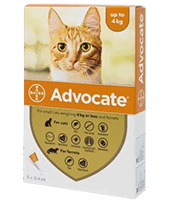
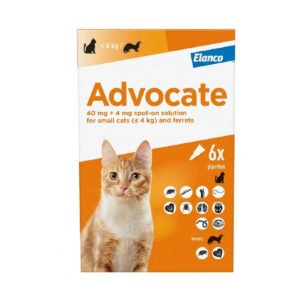
Topical spot-on medications are applied as a liquid directly to the cat's skin, typically at the base of the skull, where the cat cannot reach to lick the application site. The active ingredients are either absorbed transdermally into the bloodstream or distributed across the skin's surface oils, depending on the compound. This format delivers both systemic coverage against internal parasites and contact-based coverage against external parasites. The following products in this category are available through Anipetshop:- Advocate: Imidacloprid acts on the flea nervous system on contact, while moxidectin targets heartworm larvae, intestinal roundworms, hookworms, and lungworms systemically.
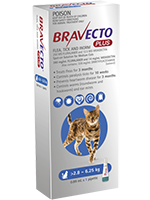
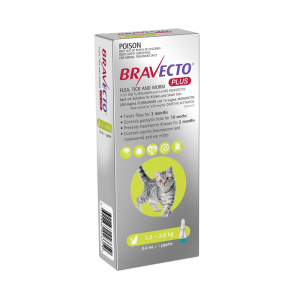
- Bravecto Plus: Fluralaner inhibits GABA-gated chloride channels in flea and tick nervous systems, providing 2 months of coverage per dose alongside heartworm prevention.
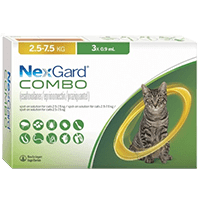
- NexGard Combo: Praziquantel extends coverage to tapeworms, which most other topical heartworm preventatives do not address.
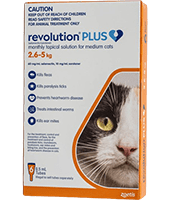
- Revolution: Selamectin is absorbed transdermally and acts systemically against heartworm larvae, fleas, ear mites, and certain intestinal worms.
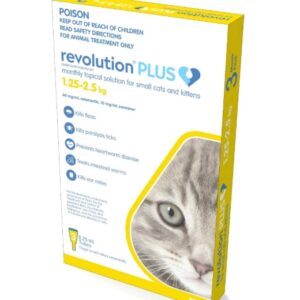
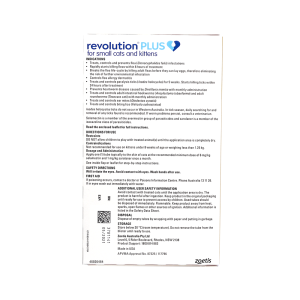
- Revolution Plus: Sarolaner is an isoxazoline-class compound added to selamectin's base coverage, extending protection to ticks that Revolution alone does not reliably control.
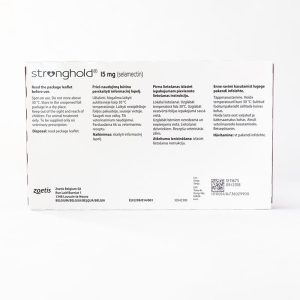
- Stronghold: The international market formulation of Revolution. Active ingredient, concentration, and mechanism are identical to the U.S. product.
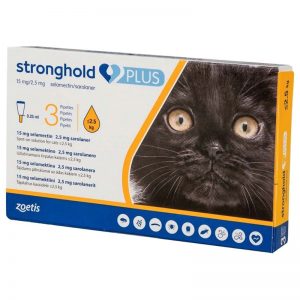
- Stronghold Plus: The international market formulation of Revolution Plus. Dual-compound mechanism and parasite coverage are equivalent to Revolution Plus.
2. Oral Chewables
Oral heartworm preventatives for cats are formulated as flavored chewable tablets. Once ingested, the active ingredients are absorbed through the gastrointestinal tract into the bloodstream, where they act systemically against heartworm larvae and, depending on the product, intestinal parasites. This format is not affected by bathing or water exposure after administration.Cat Heartworm Preventatives Available at Anipetshop
Seven topical spot-on formulations for cat heartworm prevention are currently stocked at Anipetshop, covering a range of parasite targets from heartworm larvae and intestinal worms to fleas, ticks, and mites. Products vary by active ingredient combination, duration per dose, and parasite coverage scope. Selecting the appropriate product depends on the cat's parasite exposure profile, tolerance for topical application, and whether multi-parasite coverage in a single dose is required. The table below compares each product by description, target users, key advantages, and usage guidelines to support an informed selection: Here is the comparison table for 7 flea and tick medication brands for cats available at Anipetshop:|
Brand |
Description | Target Users | Advantages |
Usage Guidelines |
|
Revolution |
Topical solution containing selamectin. Targets fleas, heartworm larvae, ear mites, roundworms, and hookworms. | Kittens 8+ weeks old, weighing at least 2.8 lbs. Safe for breeding, pregnant, and lactating cats. | Broad-spectrum protection with one monthly application. Safe across all life stages including pregnant and lactating cats. |
Apply monthly to skin at base of neck. Do not bathe cat for 24 hours after application. |
|
Revolution Plus |
Dual-action topical solution with selamectin + sarolaner. Adds tick coverage over standard Revolution. | Kittens 8+ weeks old, weighing at least 2.8 lbs. Not evaluated for pregnant or lactating cats. | Kills fleas, ticks, ear mites, roundworms, hookworms, and heartworm larvae in one monthly dose. |
Apply monthly at base of neck. Waterproof within 2 hours; wait 24 hours before bathing. |
|
Stronghold |
Selamectin-based topical solution. Covers fleas, heartworms, ear mites, roundworms, and hookworms. | Kittens 6+ weeks old. Safe for breeding, pregnant, and lactating cats. | Broadest minimum age threshold (6 weeks). Safe for all life stages. Dosage available for cats up to 20 lbs. |
Apply monthly to skin at base of skull. Wait 24 hours before bathing. |
|
Stronghold Plus |
Selamectin + sarolaner combination. Extends coverage to include ticks and lice beyond standard Stronghold. | Kittens 8+ weeks old, weighing at least 2.8 lbs. Safe for breeding, pregnant, and lactating cats. | Covers fleas, ticks, heartworms, ear mites, roundworms, hookworms, and lice. Safe for pregnant and lactating cats, unlike Revolution Plus. |
Apply monthly to skin between shoulder blades. Prevent cat from licking for 24 hours post-application. |
|
Advocate |
Dual-ingredient topical solution: imidacloprid + moxidectin. Covers fleas, heartworms, intestinal worms, and ear mites. | Kittens 9+ weeks old, weighing at least 2.0 lbs. Safety not established for pregnant or lactating cats. | Lowest minimum weight threshold (2.0 lbs). Kills whipworms in addition to roundworms and hookworms. |
Apply monthly to skin at base of skull. Avoid bathing until product is fully dry. |
|
Bravecto Plus |
Fluralaner + moxidectin topical solution. Provides up to 12 weeks of protection per dose. | Kittens 6+ months old, weighing at least 2.6 lbs. Not evaluated for pregnant or breeding cats. | Longest protection period among topicals: one dose covers 3 months. Kills fleas within 12 hours, achieving nearly 100% efficacy. Covers roundworms, hookworms, ticks, and heartworms. |
Apply every 12 weeks at base of neck. Wait at least 3 days before bathing after application. |
|
NexGard Combo |
Triple-action topical: esafoxolaner + eprinomectin + praziquantel. The only formula in this list that covers tapeworms. | Kittens 8+ weeks old, weighing at least 1.8 lbs. Safety not established for pregnant or lactating cats. | Only product covering tapeworms in addition to fleas, ticks, heartworms, roundworms, hookworms, and ear mites. Second-lowest minimum weight threshold (1.8 lbs). |
Apply monthly to skin at base of skull. Store at 59-86°F. Do not apply two doses at once if a dose is missed. |
How to Choose a Cat Heartworm Preventative
Selecting a cat heartworm preventative requires matching the product's active ingredient profile to the cat's parasite exposure, weight, age, and tolerance for each administration format. No single product is appropriate for every cat: a strictly indoor kitten requires a different formulation than an adult outdoor cat in a multi-pet household. The five steps below provide a structured basis for product selection before placing an order:
Step 1: Schedule a Veterinary Heartworm Test A heartworm test is required before starting any preventative. If a cat carries an active infection and a preventative is administered, the rapid die-off of microfilariae can trigger acute lung injury or circulatory shock. A veterinarian will screen via blood sample for heartworm antigens and circulating microfilariae.
Step 2: Confirm Age and Weight Before Ordering Heartworm preventative dosing is weight-dependent: an incorrect dose risks either inadequate larval coverage or toxicity. Weigh the cat before selecting a product. As a reference: a 4.5 kg cat falls within the Revolution Plus band for cats 2.5 to 7.5 kg, while a 1.8 kg kitten requires the lowest weight-band formulation. Age eligibility varies by product: Revolution Plus is labeled from 8 weeks, Advocate from 9 weeks.
Step 3: Assess Your Cat's Parasite Exposure Profile The appropriate product depends on the cat's living environment and household composition. The three scenarios below map to distinct coverage requirements:
- Outdoor or indoor-outdoor cats: Tick exposure is a realistic risk alongside heartworm and fleas. A dual-compound topical such as Revolution Plus or NexGard Combo covers all three parasite categories in one monthly application.
- Strictly indoor cats: Heartworm transmission remains possible via indoor mosquitoes, but broad-spectrum tick coverage is not necessary for most strictly indoor cats.
- Multi-pet households: A cat sharing an environment with a flea-infested animal requires a product with active flea adulticidal activity to interrupt cross-infestation.
Step 4: Select the Delivery Format Format selection should be based on the cat's tolerance for each administration method and household-specific factors.
- Topical spot-on: Indicated for cats that resist oral dosing, or when multi-parasite coverage including fleas and ticks is required without a separate product. The application site must remain dry for 2 to 24 hours post-application.
- Oral chewable: Indicated for cats with skin sensitivities at topical application sites, or in households with young children who may contact the cat's fur before the application has dried. Unaffected by bathing after ingestion.
Step 5: Administer the First Dose and Monitor For topical spot-ons, apply the liquid directly to the skin at the base of the skull, not to the fur, and prevent the cat from grooming the site until fully dried. Monitor for 24 hours after the first dose for lethargy, vomiting, excessive drooling, or application site redness. Set a fixed calendar reminder for each subsequent dose: one missed month creates a gap in larval coverage during which transmitted larvae can survive and develop.
Order Cat Heartworm Preventatives Without a U.S. Prescription
Cat heartworm preventatives are available through Anipetshop without a U.S. veterinary prescription, dispensed under Australian APVMA licensing. All products are sourced directly from their original manufacturers, including Zoetis, Boehringer Ingelheim, and Elanco, with no generic substitutions. The active ingredient concentrations, dosage standards, and labeling comply with the same manufacturer specifications as the equivalent products sold in the United States. The following product standards apply to all orders:- Original manufacturer sourcing: Products are supplied directly from manufacturers in Australia and Europe, with no third-party repackaging or reformulation.
- English-language labeling: All products are labeled in English, with full ingredient listings, dosing instructions, and weight band specifications as issued by the manufacturer.
- Verified expiration dates: Each product carries a manufacturer-issued expiration date confirming active ingredient stability through the labeled period.
- Identical formulation to U.S. market products: Active ingredients, concentrations, and dosage forms match the prescription equivalents currently on the U.S. market. No generics or substitute compounds are stocked.
How to Administer Cat Heartworm Preventatives
The administration method is determined by the product format: topical spot-ons are applied directly to the skin, while oral formulations are given by mouth as a chewable or tablet. The critical requirement for topical products is skin contact, not fur contact. Liquid deposited onto fur rather than skin will not absorb correctly and will reduce the delivered dose.1. How to Apply a Topical Spot-On
The following steps apply to all topical spot-on formulations. Deviating from the application site or technique reduces transdermal absorption and may leave the cat inadequately protected.- Step 1: Secure the cat on a stable surface. Position the cat facing away from you on a table or firm surface. This orientation gives you clear access to the back of the neck and reduces movement during application.
- Step 2: Part the fur at the base of the skull. Separate the hair to expose the skin directly at the base of the skull, not between the shoulder blades, unless the product label specifies otherwise. This site is used because the cat cannot reach it to lick the application area.
- Step 3: Open the tube. Hold the tube upright and puncture the seal by pressing or clicking the cap as directed on the packaging, then remove the cap.
- Step 4: Apply the full contents directly to skin. Press the tube tip against the exposed skin and squeeze the entire contents in one location. Do not drag the tube across the skin: dispersing the liquid across multiple sites reduces the concentration at the primary absorption point.
- Step 5: Keep the site dry until fully absorbed. Do not touch the application area or bathe the cat until the product has dried. The required drying period varies by product: check the individual product label, as the window ranges from 2 to 24 hours.
2. How to Administer an Oral Chewable or Tablet
Oral heartworm preventatives for cats are administered either by offering the chewable directly or by manually placing the tablet at the back of the tongue. The method used depends on whether the cat will voluntarily ingest the formulation.- Food concealment method: Offer the chewable as a standalone treat first. If the cat refuses, crumble the dose into a small portion of wet food or a lickable paste treat and confirm the entire dose has been consumed before offering additional food.
- Manual pilling method: Grip the cat's head from above with the non-dominant hand, placing the thumb and index finger on either side of the upper jaw. Tilt the head back until the nose points upward, which causes the lower jaw to drop slightly. Use the other hand to open the lower jaw fully and place the tablet as far back on the tongue as possible. Close the mouth and stroke the throat downward or briefly blow on the nose to trigger the swallowing reflex. Confirm the tablet has been swallowed before releasing the cat.
Are There Any Side Effects of Heartworm Medicine for Cats?
Cat heartworm preventatives are associated with a defined set of adverse reactions, ranging from transient local irritation at the application site to rare but serious neurological effects. The frequency and severity of reactions vary by active ingredient class. Most reactions present within 24 hours of administration. The reactions below are organized by route of administration. Most resolve without intervention within 24 to 48 hours, but persistent or worsening symptoms require veterinary assessment. Topical spot-on reactions:- Application site irritation: Temporary hair loss, localized redness, itching, or a powdery residue at the application site. These reactions reflect localized skin response to the carrier solvent, not the active ingredient itself.
- Oral ingestion of topical product: If the cat licks the application site before the product has dried, the carrier solvent produces excessive drooling or foaming at the mouth due to its bitter taste. This is not a toxic reaction, but the application site should be monitored until fully dry to prevent ingestion.
- Gastrointestinal upset: Mild vomiting or diarrhea occurring within hours of administration. If vomiting occurs within 1 hour of giving an oral dose, the full dose may not have been absorbed and a veterinarian should be consulted before redosing.
- Transient behavioral changes: Lethargy, drowsiness, or reduced appetite lasting up to 24 hours post-administration. Symptoms persisting beyond 48 hours, or accompanied by ataxia or disorientation, require veterinary evaluation.