Free Shipping on Orders Over $99*

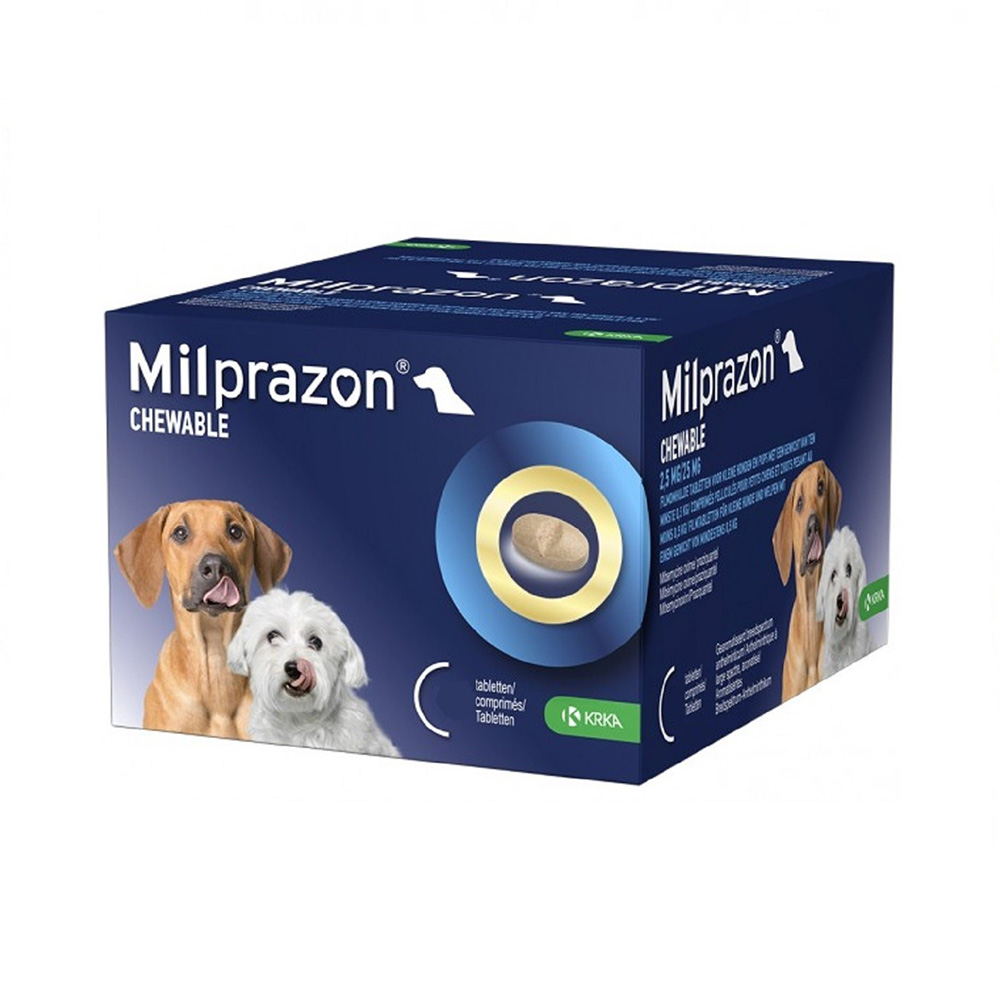
Milprazon 2.5mg/25mg for Small Dogs and Puppies

💊
NO PRESCRIPTION NEEDED
Safe Over-The-Counter Product
AU
BASED IN AUSTRALIA
Tracked Delivery 7-14 Days
💰
MONEY BACK GUARANTEE
No questions asked, return within 30 days
🛡️
GENUINE BRANDED PRODUCT
Guaranteed original, factory sealed for safety
Description
Milprazon 2.5mg/25mg for Small Dogs and Puppies delivers dual-active anthelmintic therapy through a combination of milbemycin oxime and praziquantel in a single oral tablet. The formulation targets both nematode and cestode infections concurrently, addressing mixed parasitic burdens with a single monthly dose. Each tablet is scored to allow division into equal halves, enabling precise dosing for puppies at the lower boundary of this weight band (0.5 kg to 1 kg). Palatability studies indicate voluntary acceptance in over 80% of animals studied.
Recommended for: Small dogs and puppies weighing 0.5 kg to 5 kg, from 2 weeks of age.
Indication/Coverage
For dogs suffering from, or at risk from, mixed parasitic infections, the labeled indications for Milprazon 2.5 mg/25 mg cover the following:
- Dipylidium caninum (tapeworm): Treatment of adult cestode infection; concurrent flea and lice control is recommended to interrupt the parasite’s lifecycle and prevent re-infestation.
- Taenia spp. (tapeworm): Treatment of adult cestode infection in the gastrointestinal tract.
- Echinococcus spp. (hydatid tapeworm): Treatment of adult cestode infection; this genus is zoonotic and notifiable to WOAH, requiring local regulatory guidance for follow-up protocols.
- Mesocestoides spp. (tapeworm): Treatment of adult cestode infection.
- Ancylostoma caninum (hookworm): Treatment of adult nematode infection causing intestinal blood loss, particularly in young or debilitated dogs.
- Toxocara canis (roundworm): Treatment of adult nematode infection; zoonotic potential warrants attention in households with children.
- Toxascaris leonina (roundworm): Treatment of adult nematode infection of the gastrointestinal tract.
- Trichuris vulpis (whipworm): Treatment of adult nematode infection causing large intestinal inflammation.
- Crenosoma vulpis (fox lungworm): Reduction of infection burden; does not achieve complete elimination at a single standard dose.
- Angiostrongylus vasorum (French heartworm): Reduction of immature adult (L5) and adult parasite burden. Milbemycin oxime should be given four times at weekly intervals. Use Milprazon for the first weekly dose, then use a milbemycin oxime-only product for the next 3 weekly doses if tapeworm treatment is also needed. In endemic areas where concurrent tapeworm treatment is required, monthly dosing with Milprazon reduces ongoing parasite burden.
- Thelazia callipaeda (eyeworm): Treatment requires two milbemycin oxime administrations seven days apart. Where concomitant tapeworm treatment is indicated, Milprazon can replace the monovalent milbemycin oxime product for this schedule.
- Dirofilaria immitis (heartworm, prevention only): Monthly dosing prevents establishment of larval heartworm when concomitant tapeworm treatment is indicated; this product is not a stand-alone heartworm preventive and is not labeled for adulticidal therapy.
Key Benefits
Milprazon 2.5 mg/25 mg addresses the clinical requirements of small-breed and puppy deworming through the following pharmacological properties:
- Minimum age suitability: Labeled for puppies from 2 weeks of age weighing at least 0.5 kg, covering the earliest period of life when nematode and cestode exposure is clinically significant.
- Dual drug class coverage: Milbemycin oxime targets nematodes and heartworm larvae; praziquantel targets cestodes and trematodes. A single tablet treats mixed infections without requiring separate products for each parasite class.
- Nematode mechanism: Milbemycin oxime increases membrane permeability to chloride ions via glutamate-gated chloride channels, inducing hyperpolarisation and flaccid paralysis in nematodes and insect larvae at the neuromuscular junction.
- Cestode mechanism: Praziquantel alters calcium membrane permeability in cestode tegument, triggering rapid muscular tetany, tegumental disintegration, and expulsion from the gastrointestinal tract.
- Palatability rate: Voluntary acceptance was recorded in over 80% of animals studied, reducing the clinical need for forced oral administration in most patients.
- Tablet division for small patients: The scored tablet divides into equal halves, permitting accurate dosing for puppies in the 0.5 kg to 1 kg range without dose estimation or compounding.
- Heartworm prevention when cestode treatment is concurrent: In heartworm-risk areas where tapeworm treatment is also indicated, Milprazon replaces the single-ingredient milbemycin product, consolidating two parasite control objectives into one tablet.
- Safe during reproduction: The product is labeled for use during pregnancy and lactation, and in breeding animals, based on available reproductive safety data from the manufacturer KRKA.
Caution
Hazards to Humans
Accidental ingestion of a tablet by a child may cause harm; store and administer this product out of sight and reach of children. If a child ingests one or more tablets, seek medical attention immediately and present the package leaflet to the treating physician. Wash hands after handling the product or administering it to an animal.
Hazards to Domestic Animals
Do not administer to puppies under 2 weeks of age or weighing less than 0.5 kg; dosing below this threshold has not been studied. Dogs with severely compromised kidney or liver function, or those in a debilitated state, should be assessed by a veterinarian before treatment commences, as no safety data exist for these animals. The macrocyclic lactone class, to which milbemycin oxime belongs, carries a reduced margin of safety in Collie and related MDR1-affected breeds; the recommended dose should be observed precisely in these animals. In heartworm-endemic areas, or for dogs with recent travel history to such regions, a veterinary consultation is advised before use to rule out existing adult heartworm infection, since the product is not labeled for adulticidal therapy. Concurrent use with other macrocyclic lactones requires caution in the absence of full interaction data.
Possible Side Effects
Monitor your dog after administration for any change in behavior or physical condition, particularly following the first dose.
The following adverse reactions have been reported at very rare frequency (fewer than 1 in 10,000 animals treated):
- Hypersensitivity reactions: Dogs carrying a high burden of circulating microfilariae may develop pale mucous membranes, vomiting, trembling, laboured breathing, or excessive salivation following administration; these reactions result from protein release during microfilariae death, not from direct drug toxicity.
- Neurological signs: Muscle tremors and ataxia have been reported at very rare frequency; Collie and related MDR1-affected breeds carry a narrower margin of safety with milbemycin oxime and require strict adherence to the labeled dose.
- Gastrointestinal signs: Emesis, diarrhoea, anorexia, and drooling have been recorded at very rare frequency following oral administration.
- Systemic signs: Lethargy has been documented at very rare frequency.
If any of these signs appear following administration, consult a veterinarian before giving the next scheduled dose.
Direction
Milprazon 2.5mg/25mg for Small Dogs and Puppies is administered orally. The tablet should be given with or after a small amount of food to support absorption and reduce the likelihood of gastrointestinal upset. If the dog does not accept the tablet voluntarily, it may be placed directly into the mouth. Body weight should be verified on the day of dosing to confirm the correct tablet size before administration.How to Open
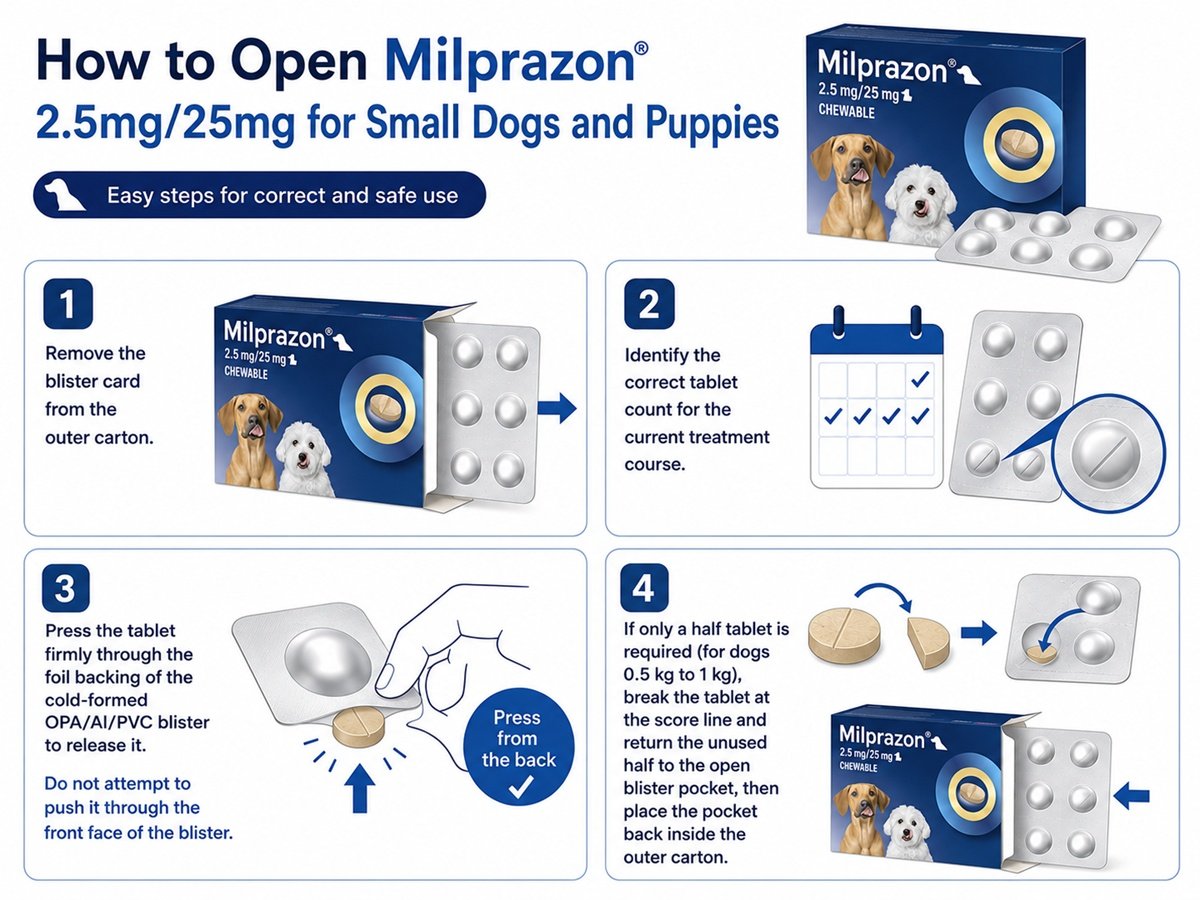
- Remove the blister card from the outer carton.
- Identify the correct tablet count for the current treatment course.
- Press the tablet firmly through the foil backing of the cold-formed OPA/Al/PVC blister to release it. Do not attempt to push it through the front face of the blister.
- If only a half tablet is required (for dogs 0.5 kg to 1 kg), break the tablet at the score line and return the unused half to the open blister pocket, then place the pocket back inside the outer carton.
How to Administer
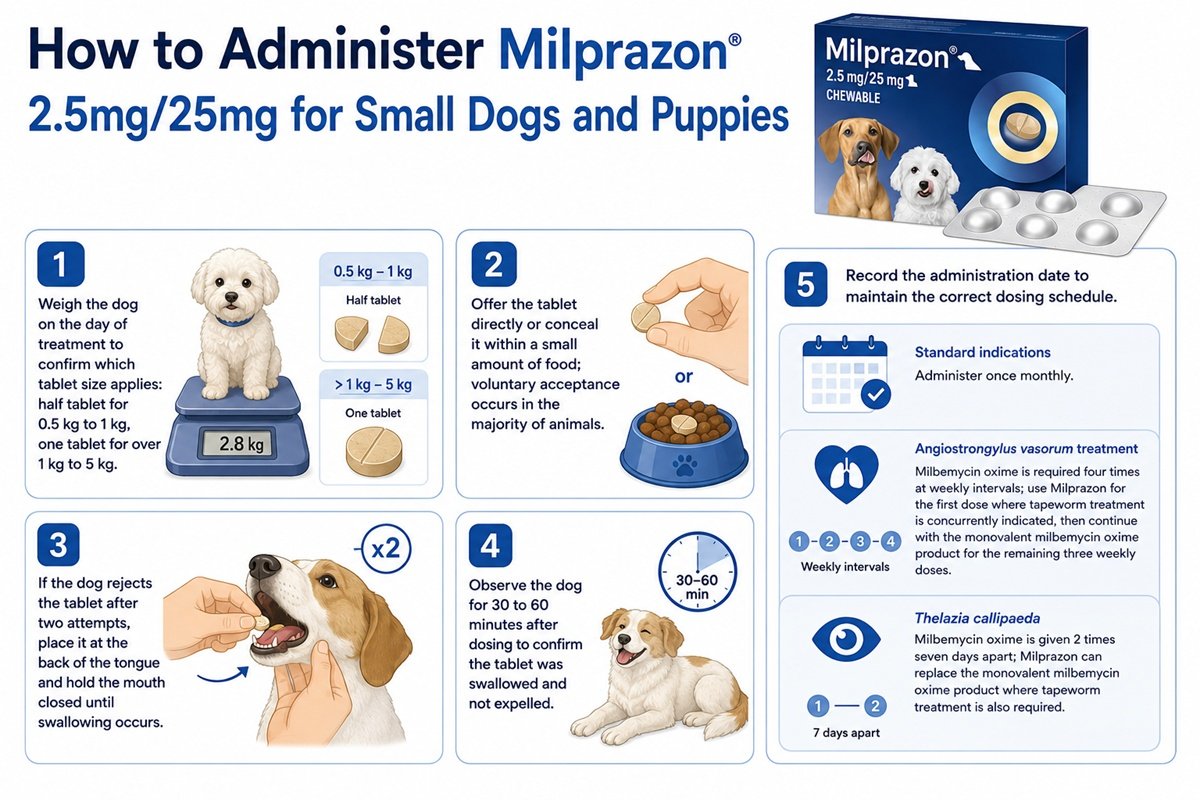
- Weigh the dog on the day of treatment to confirm which tablet size applies: half tablet for 0.5 kg to 1 kg, one tablet for over 1 kg to 5 kg.
- Offer the tablet directly or conceal it within a small amount of food; voluntary acceptance occurs in the majority of animals.
- If the dog rejects the tablet after two attempts, place it at the back of the tongue and hold the mouth closed until swallowing occurs.
- Observe the dog for 30 to 60 minutes after dosing to confirm the tablet was swallowed and not expelled.
- Record the administration date to maintain the correct dosing schedule.
- For standard indications, administer once monthly.
- For Angiostrongylus vasorum treatment, milbemycin oxime is required four times at weekly intervals; use Milprazon for the first dose where tapeworm treatment is concurrently indicated, then continue with the monovalent milbemycin oxime product for the remaining three weekly doses.
- For Thelazia callipaeda, milbemycin oxime is given 2 times seven days apart; Milprazon can replace the monovalent milbemycin oxime product where tapeworm treatment is also required.
Storage
Keep out of reach of children. Store in the original packaging to protect from moisture; no special temperature requirement applies to whole tablets. Halved tablets should be stored below 25°C (77°F) in the original blister pocket and used at the next scheduled administration. Do not use the product after the expiry date printed on the packaging; the expiry date refers to the last day of the stated month. Shelf life for the sealed product is 3 years from the date of manufacture; halved tablets stored in the original blister are stable for up to 6 months.Tips for Using
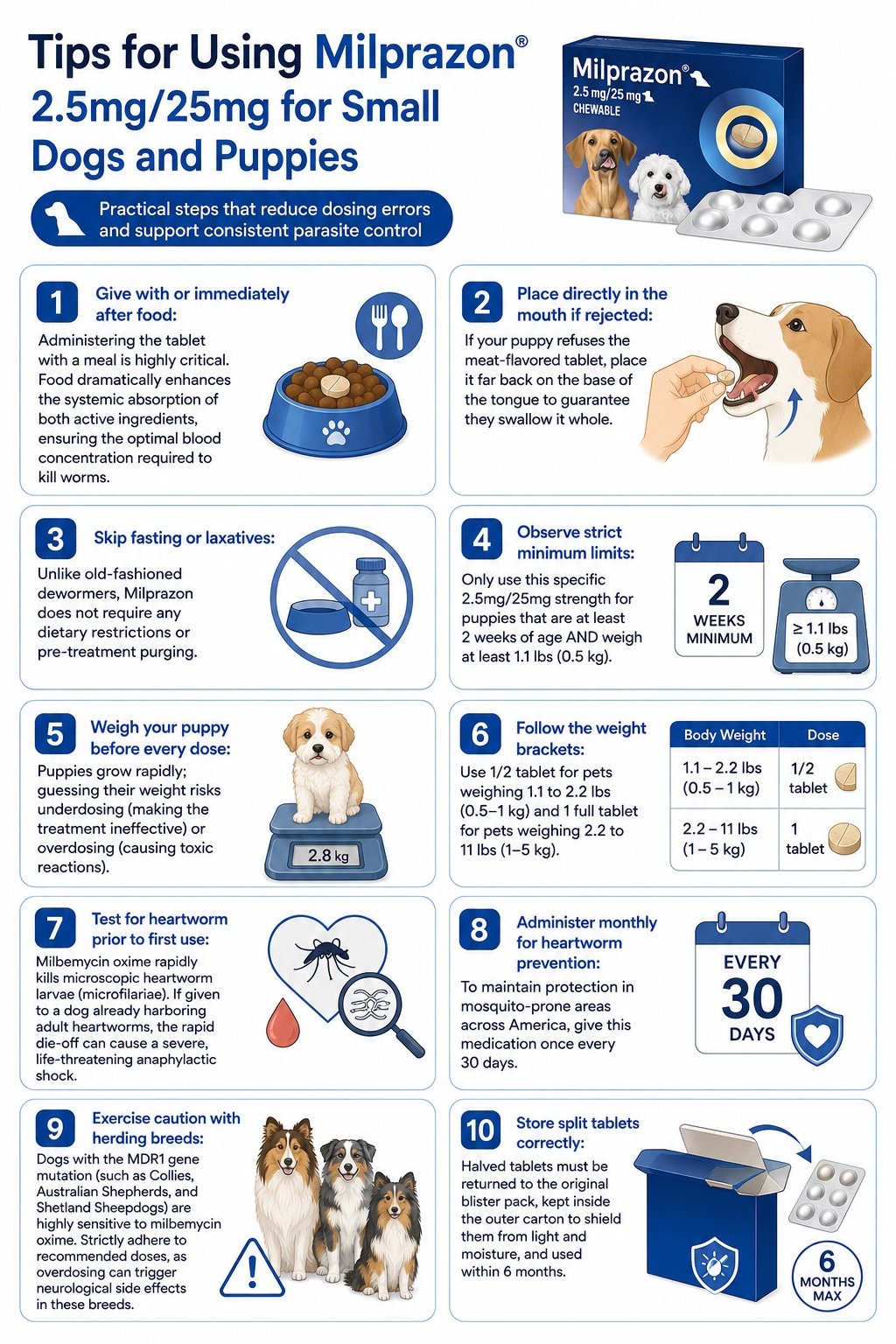
Practical steps that reduce dosing errors and support consistent parasite control:- Give with or immediately after food: Administering the tablet with a meal is highly critical. Food dramatically enhances the systemic absorption of both active ingredients, ensuring the optimal blood concentration required to kill worms.
- Place directly in the mouth if rejected: If your puppy refuses the meat-flavored tablet, place it far back on the base of the tongue to guarantee they swallow it whole.
- Skip fasting or laxatives: Unlike old-fashioned dewormers, Milprazon does not require any dietary restrictions or pre-treatment purging.
- Observe strict minimum limits: Only use this specific 2.5mg/25mg strength for puppies that are at least 2 weeks of age AND weigh at least 1.1 lbs (0.5 kg).
- Weigh your puppy before every dose: Puppies grow rapidly; guessing their weight risks underdosing (making the treatment ineffective) or overdosing (causing toxic reactions).
- Follow the weight brackets: Use 1/2 tablet for pets weighing 1.1 to 2.2 lbs (0.5–1 kg) and 1 full tablet for pets weighing 2.2 to 11 lbs (1–5 kg).
- Test for heartworm prior to first use: Milbemycin oxime rapidly kills microscopic heartworm larvae (microfilariae). If given to a dog already harboring adult heartworms, the rapid die-off can cause a severe, life-threatening anaphylactic shock.
- Administer monthly for heartworm prevention: To maintain protection in mosquito-prone areas across America, give this medication once every 30 days.
- Exercise caution with herding breeds: Dogs with the MDR1 gene mutation (such as Collies, Australian Shepherds, and Shetland Sheepdogs) are highly sensitive to milbemycin oxime. Strictly adhere to recommended doses, as overdosing can trigger neurological side effects in these breeds.
- Store split tablets correctly: Halved tablets must be returned to the original blister pack, kept inside the outer carton to shield them from light and moisture, and used within 6 months.
| Product Name | Milprazon 2.5mg/25mg for Small Dogs and Puppies |
|---|---|
| Target Weight | 0.5 kg to 5 kg (approximately 1.1 lbs to 11 lbs) |
| Tablet Size | Scored oval tablet, divisible into equal halves |
| Active Ingredients | Milbemycin oxime: 2.5 mg per tablet, Praziquantel: 25.0 mg per tablet |
| Key Excipients | colloidal anhydrous silica, croscarmellose sodium, hypromellose, lactose monohydrate, liver flavour, magnesium stearate, meat flavour, Microcrystalline cellulose, povidone, propylene glycol, talc, yeast |
| Application | Chewable oral tablet; film-coated, palatable formulation |
| Appearance | Pale yellowish brown, oval, biconvex, mottled, film-coated tablet with a score line on one side |
| Administration Route | Oral administration; given with or after food |
| Pack Sizes Available | 2-tablet blister (1 blister), 4-tablet blister (1 blister), or 48-tablet bulk pack (12 blisters of 4 tablets) |
| Treatment Frequency | Angiostrongylus vasorum treatment: 4 milbemycin oxime doses at weekly intervals, followed by monovalent milbemycin oxime for doses from 2 to 4., Milprazon can substitute the monovalent product where tapeworm treatment is also indicated., Milprazon covers dose 1 where concurrent tapeworm treatment is indicated, Monthly for most indications and heartworm prevention, Thelazia callipaeda treament: 2 milbemycin oxime doses, 7 days apart |
| Effective Against | – Common tapeworm (Dipylidium caninum, adults) |
| Storage | Store below 25°C (77°F) in the original blister |
FAQs
My puppy weighs exactly 0.5 kg today. Can I give the Milprazon 2.5 mg/25 mg tablet?
Yes, 0.5 kg is the labeled minimum for this product. Puppies below 0.5 kg or under 2 weeks of age fall outside the studied range and should not receive this tablet. Weigh on the day of dosing, not from a prior estimate, to confirm eligibility before administering.
My puppy is under 2 weeks old but already weighs 0.5 kg. Is the tablet safe to give?
No. The minimum age requirement is 2 weeks, irrespective of body weight. Tapeworm infection in puppies under 4 weeks of age is also clinically uncommon, so combination treatment is unlikely to be necessary at that stage. Consult a veterinarian to determine the appropriate start date.
My small dog just moved from the 0.5 to 1 kg range into the 1 to 5 kg range. Do I switch to a full tablet immediately?
Yes. Once the dog’s verified body weight exceeds 1 kg on the day of dosing, a full 2.5 mg/25 mg tablet is the correct dose. Administering a half tablet to a dog over 1 kg results in underdosing, which may not eliminate the full parasite burden. Confirm the current weight before each monthly dose while the dog is still growing.
Is the milbemycin oxime dose in this variant safe for a puppy at exactly 0.5 kg?
The labeled minimum recommended dose is 0.5 mg milbemycin oxime per kg body weight. A half tablet delivers 1.25 mg milbemycin oxime, which meets the minimum dose at 0.5 kg. Collie and related MDR1-affected breeds carry a narrower margin of safety with this drug class; for those breeds, strict adherence to the weight-based dose is particularly important, and a veterinary assessment is advisable before the first dose.
What do I do if I miss a monthly dose for my small dog?
Administer the missed dose as soon as the gap is identified, then resume the regular monthly schedule from that date. Do not double-dose to compensate. An extended dosing interval creates a window during which larval stages, particularly heartworm larvae and Angiostrongylus vasorum at the immature adult stage, may develop beyond the stage that milbemycin oxime suppresses effectively.
My small dog has a Collie lineage. Is Milprazon 2.5 mg/25 mg appropriate?
Dogs of Collie or related breeds have a reduced margin of safety with milbemycin oxime, the macrocyclic lactone in this product. The product remains usable in these animals, but the labeled dose should be observed precisely without any upward adjustment. Consult a veterinarian before starting this product in MDR1-susceptible breeds, particularly if the dog has not previously been tested for the MDR1 gene mutation.
Can this tablet be given to a pregnant or nursing small dog?
Yes. The product is labeled for use during pregnancy, lactation, and in breeding animals based on available safety data from KRKA. No contraindication to reproductive use is stated in the current SPC. For debilitated or systemically unwell animals, a veterinarian should conduct a benefit-risk assessment before treatment proceeds.
My small dog lives in a heartworm-endemic area. Does this product replace monthly heartworm prevention?
Milprazon 2.5 mg/25 mg provides heartworm prevention through monthly milbemycin oxime dosing when concomitant tapeworm treatment is also required. It is not labeled as a stand-alone heartworm preventive and carries no adulticidal activity against established adult Dirofilaria immitis. Before starting this product in a heartworm-endemic area, a veterinary consultation is advised to exclude existing adult heartworm infection; if adult infection is confirmed, adulticidal treatment is required prior to initiating milbemycin-based prevention.
Can I store a half tablet for use next month?
Yes. A half tablet stored in the original blister pocket below 25°C (77°F) is stable for up to 6 months, which covers the next monthly dose. However, storing it loose or at elevated temperatures compromises the film coating. Return the unused half to the scored blister, place it back in the outer carton, and administer it at the following month’s dose.
What should I watch for after giving the first dose to my puppy?
Observe the puppy for 15 to 30 minutes following the initial administration. At a very rare frequency, adverse signs include vomiting, diarrhoea, drooling, muscle tremors, ataxia, or lethargy. Puppies with undetected microfilaremia may exhibit hypersensitivity reactions including pale mucous membranes, trembling, or laboured breathing as dying microfilariae release proteins. If any of these signs appear, contact a veterinarian before the next scheduled dose.
Add a review
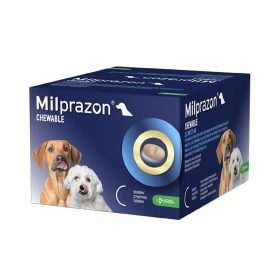 Milprazon 2.5mg/25mg for Small Dogs and Puppies
Your review
* Review is required
Name
* Name is required
Email
* Email is required
Add photos or video to your review
Related Products
Sale!

Price range: US$59.50 through US$99.65
This product has multiple variants. The options may be chosen on the product page

Price range: US$59.20 through US$189.60
This product has multiple variants. The options may be chosen on the product page

Price range: US$52.10 through US$175.70
This product has multiple variants. The options may be chosen on the product page
Sale!

Price range: US$54.50 through US$85.50
This product has multiple variants. The options may be chosen on the product page
Price range: US$68.80 through US$128.50
This product has multiple variants. The options may be chosen on the product page
Price range: US$62.50 through US$119.50
This product has multiple variants. The options may be chosen on the product page
Price range: US$71.95 through US$139.22
This product has multiple variants. The options may be chosen on the product page
Sale!
Price range: US$73.70 through US$239.77
This product has multiple variants. The options may be chosen on the product page
Reviews
There are no reviews yet