Free Shipping on Orders Over $99*

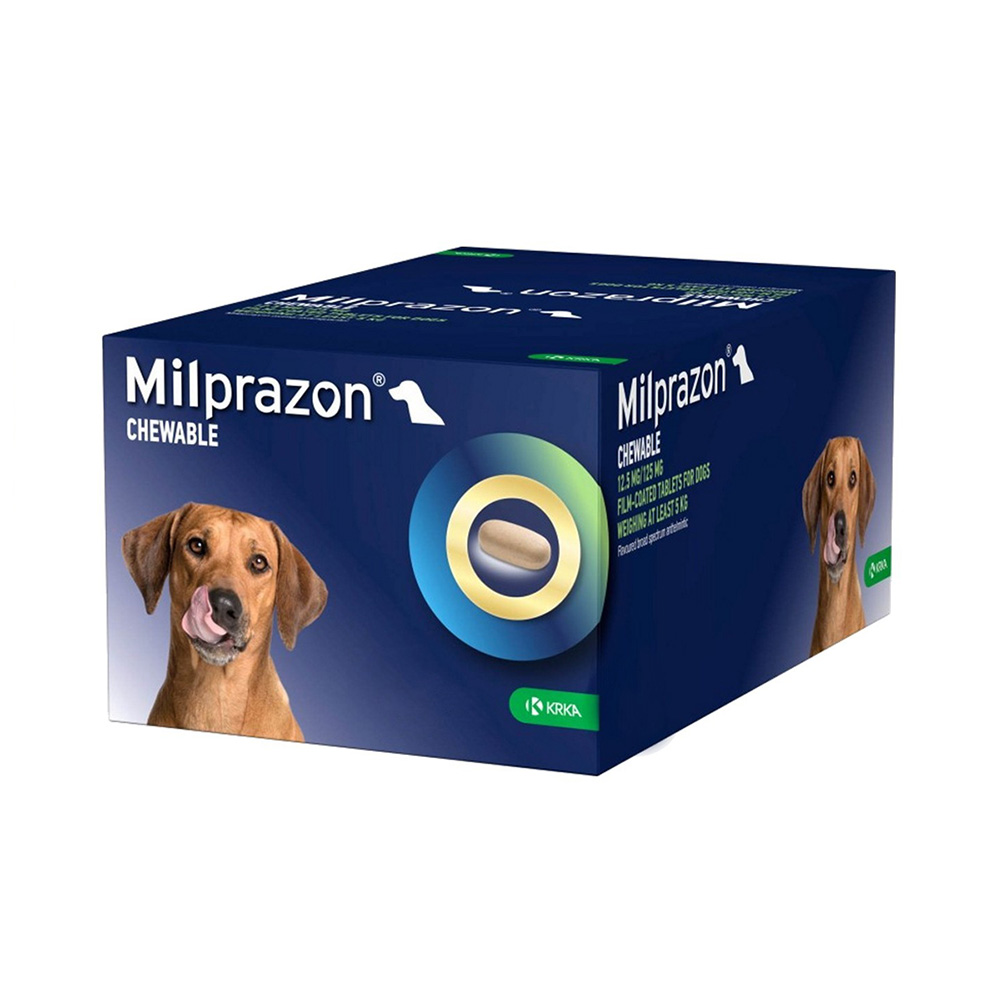
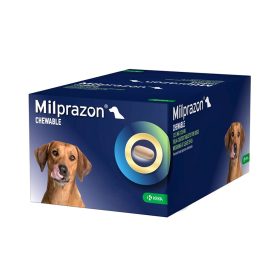
Milprazon 12.5mg/125mg for Dogs

💊
NO PRESCRIPTION NEEDED
Safe Over-The-Counter Product
AU
BASED IN AUSTRALIA
Tracked Delivery 7-14 Days
💰
MONEY BACK GUARANTEE
No questions asked, return within 30 days
🛡️
GENUINE BRANDED PRODUCT
Guaranteed original, factory sealed for safety
Description
Milprazon Chewable 12.5 mg/125 mg delivers a dual-active formulation combining milbemycin oxime and praziquantel in a single oral dose. Each film-coated tablet addresses both cestode and nematode infections simultaneously, eliminating the need for separate anthelmintic courses. Dogs weighing below 5 kg should not receive this tablet; a lower-strength variant applies to that weight range.
Recommended for: Dogs weighing 5 kg to 25 kg (approximately 11 lbs to 55 lbs).
Indication/Coverage
For dogs with, or at risk of, multiple parasitic infections, Milprazon 12.5mg/125mg is indicated for the following conditions:
- Dipylidium caninum (tapeworm): Treatment of adult cestode infection; concurrent flea and lice control is recommended to interrupt the parasite’s lifecycle and prevent re-infestation.
- Taenia spp. (tapeworm): Treatment of adult cestode infection in the gastrointestinal tract.
- Echinococcus spp. (hydatid tapeworm): Treatment of adult cestode infection; this genus is zoonotic and notifiable to WOAH, requiring local regulatory guidance for follow-up protocols.
- Mesocestoides spp. (tapeworm): Treatment of adult cestode infection.
- Ancylostoma caninum (hookworm): Treatment of adult nematode infection causing intestinal blood loss, particularly in young or debilitated dogs.
- Toxocara canis (roundworm): Treatment of adult nematode infection; zoonotic potential warrants attention in households with children.
- Toxascaris leonina (roundworm): Treatment of adult nematode infection of the gastrointestinal tract.
- Trichuris vulpis (whipworm): Treatment of adult nematode infection causing large intestinal inflammation.
- Crenosoma vulpis (fox lungworm): Reduction of infection burden; does not achieve complete elimination at a single standard dose.
- Angiostrongylus vasorum (French heartworm): Reduction of immature adult (L5) and adult parasite burden. Milbemycin oxime should be given four times at weekly intervals. Use Milprazon for the first weekly dose, then use a milbemycin oxime-only product for the next 3 weekly doses if tapeworm treatment is also needed. In endemic areas where concurrent tapeworm treatment is required, monthly dosing with Milprazon reduces ongoing parasite burden.
- Thelazia callipaeda (eyeworm): Treatment requires two milbemycin oxime administrations seven days apart. Where concomitant tapeworm treatment is indicated, Milprazon can replace the monovalent milbemycin oxime product for this schedule.
- Dirofilaria immitis (heartworm, prevention only): Monthly dosing prevents establishment of larval heartworm when concomitant tapeworm treatment is indicated; this product is not a stand-alone heartworm preventive and is not labeled for adulticidal therapy.
Key Benefits
The following benefits reflect the labeled pharmacological properties and approved indications for Milprazon Chewable 12.5 mg/125 mg:
- Dual-active formulation: Milbemycin oxime targets nematodes and heartworm larvae; praziquantel addresses cestodes. A single dose covers both parasite classes without requiring two separate products.
- Minimum weight eligibility: Labeled for dogs from 5 kg, this tablet delivers milbemycin oxime at a minimum of 0.5 mg/kg and praziquantel at 5 mg/kg. Dogs below 5 kg fall outside the approved dosing range and should not receive this formulation.
- Heartworm prevention with concurrent tapeworm coverage: Monthly administration prevents Dirofilaria immitis larval development in dogs residing in or traveling through heartworm-endemic regions, while also clearing tapeworm burden in a single treatment cycle.
- Dual mechanism of action: Milbemycin oxime increases nematode membrane permeability to chloride ions via glutamate-gated chloride channels, producing flaccid paralysis and death of the parasite. Praziquantel disrupts calcium ion permeability in cestode membranes, triggering rapid muscular contraction and tegumental disintegration.
- Palatable tablet format: Voluntary acceptance was observed in over 80% of dogs in studies, which reduces handling stress during administration. Dogs that decline to take the tablet voluntarily can receive it by direct oral placement.
- Efficacy across multiple life stages: Coverage extends to immature adult (L5) and adult stages of Angiostrongylus vasorum, and larval stages of Dirofilaria immitis, not only patent adult infections.
- Safe during pregnancy and lactation: The formulation is approved for use in breeding, pregnant, and lactating dogs, making it suitable across the full reproductive cycle without requiring dose interruption.
- Established oral absorption profile: Milbemycin oxime reaches peak plasma levels within 0.75 to 3.5 hours after administration with food. Bioavailability is approximately 80%, ensuring consistent systemic exposure at each monthly dose.
Caution
Hazards to Humans
Accidental ingestion by a child may be harmful; if this occurs, seek medical advice immediately and show the package leaflet to the physician. Administer and store tablets out of sight and reach of children, as the flavored formulation may attract unsupervised handling. Wash hands after use.
Hazards to Domestic Animals
Milprazon Chewable 12.5 mg/125 mg is for oral use only; do not administer to dogs weighing less than 5 kg or younger than 4 weeks. Dogs of Collie or related breeds have a narrower margin of safety with milbemycin oxime, and the labeled dose should be observed precisely. Use in dogs with microfilaremia is not recommended, as die-off reactions from circulating microfilariae can produce hypersensitivity responses including pale mucous membranes, vomiting, and labored breathing. Dogs with severely compromised kidney or liver function, or in debilitated condition, should only receive this product following a veterinary benefit-risk assessment. Caution is warranted when co-administering with other macrocyclic lactones, as interaction studies beyond selamectin are not available.
Possible Side Effects
Monitor your dog after each administration, particularly following the first dose. The adverse reactions documented for Milprazon Chewable 12.5 mg/125 mg are classified as very rare, occurring in fewer than 1 in 10,000 treated animals:
- Hypersensitivity reactions: These may present acutely following administration, particularly in dogs with high circulating microfilariae load. Signs include pale mucous membranes, labored breathing, and excessive salivation.
- Gastrointestinal signs: Vomiting, diarrhea, anorexia, and drooling have been reported at this frequency. Administering the tablet with food reduces the likelihood of GI intolerance.
- Systemic signs: Lethargy and neurological disturbances including muscle tremors and ataxia fall within the very rare classification. These signs are consistent with milbemycin oxime overdose effects in Collie-type breeds when the dose is not precisely observed.
If any of these signs emerge, discontinue dosing and consult a veterinarian before the next scheduled administration.
Direction
Administer Milprazon Chewable 12.5 mg/125 mg orally, with or immediately after a small amount of food. Offering the tablet with food improves praziquantel absorption and reduces the risk of gastrointestinal upset. If the dog does not voluntarily accept the tablet, place it directly into the mouth and hold the muzzle gently closed until swallowing is confirmed. Do not allow the dog to spit out and partially chew the tablet without fully swallowing, as this may result in incomplete dosing.How to Open
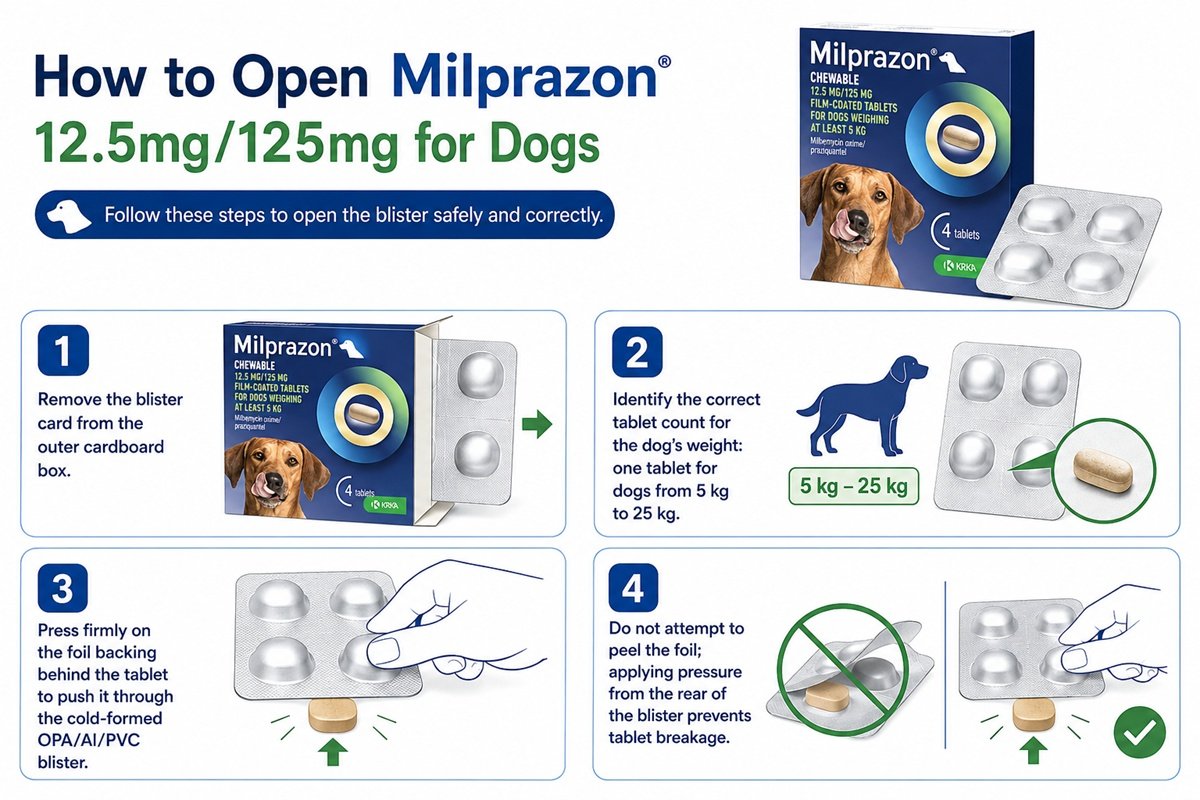
- Remove the blister card from the outer cardboard box.
- Identify the correct tablet count for the dog's weight: one tablet for dogs from 5 kg to 25 kg.
- Press firmly on the foil backing behind the tablet to push it through the cold-formed OPA/Al/PVC blister.
- Do not attempt to peel the foil; applying pressure from the rear of the blister prevents tablet breakage.
How to Administer
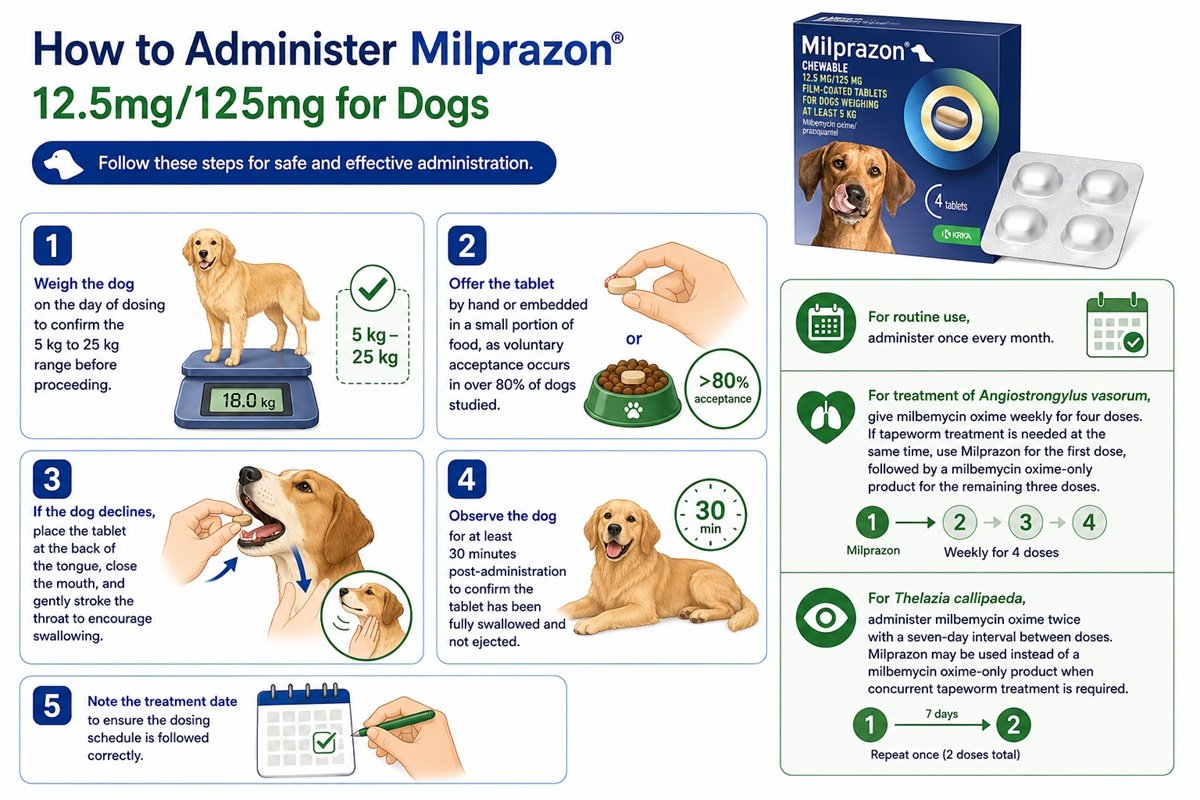
- Weigh the dog on the day of dosing to confirm the 5 kg to 25 kg range before proceeding.
- Offer the tablet by hand or embedded in a small portion of food, as voluntary acceptance occurs in over 80% of dogs studied.
- If the dog declines, place the tablet at the back of the tongue, close the mouth, and gently stroke the throat to encourage swallowing.
- Observe the dog for at least 30 minutes post-administration to confirm the tablet has been fully swallowed and not ejected.
- Note the treatment date to ensure the dosing schedule is followed correctly.
-
- For routine use, administer once every month.
- For treatment of Angiostrongylus vasorum, give milbemycin oxime weekly for four doses. If tapeworm treatment is needed at the same time, use Milprazon for the first dose, followed by a milbemycin oxime-only product for the remaining three doses.
- For Thelazia callipaeda, administer milbemycin oxime twice with a seven-day interval between doses. Milprazon may be used instead of a milbemycin oxime-only product when concurrent tapeworm treatment is required.
Storage
Store tablets out of reach of children at all times. Keep in the original blister packaging to protect against moisture; no refrigeration is required. Do not use after the expiry date printed on the outer carton. The stated expiry date refers to the last day of that month. Shelf life once packaged for sale is 3 years under these storage conditions.Tips for Using
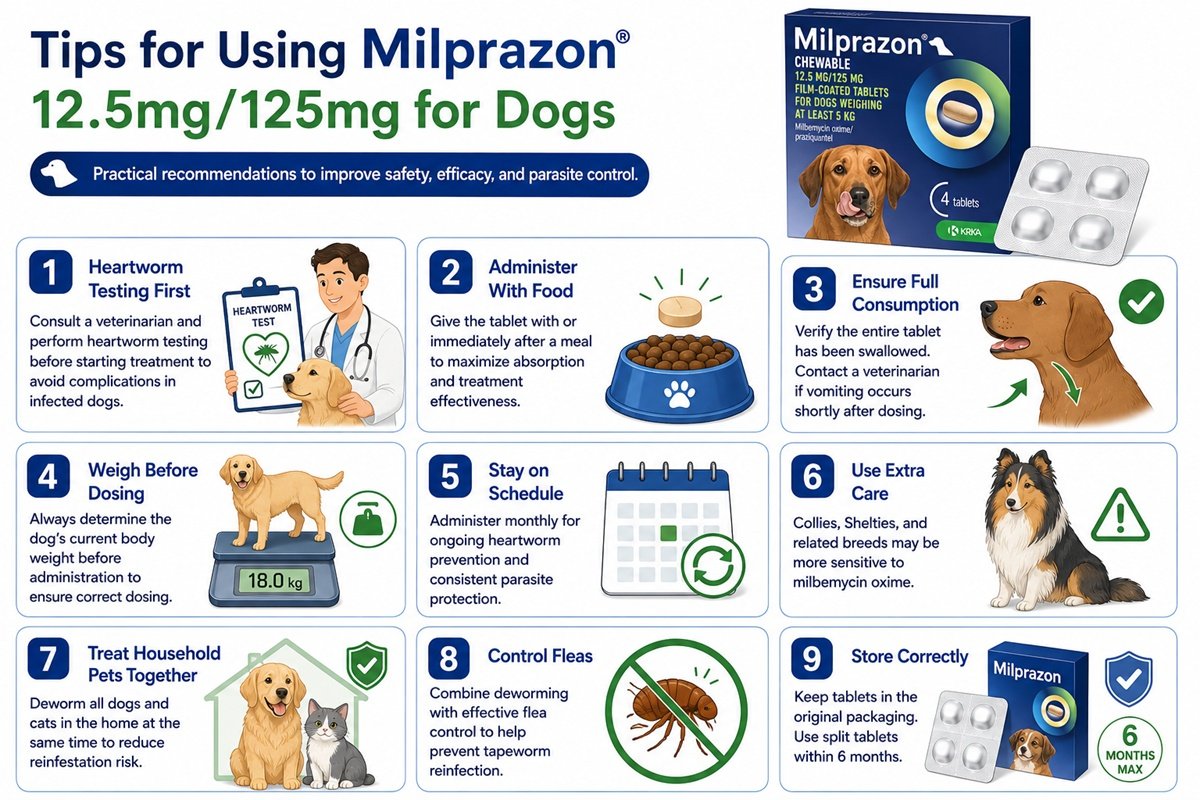
The following practical steps reduce the likelihood of dosing errors and missed treatments for dogs in the 5 kg to 25 kg range:- Veterinary Consultation and Heartworm Testing: Before starting, it is crucial to consult a veterinarian and, in the U.S., perform a heartworm antigen test to ensure your dog is not already infected with adult heartworms. This helps avoid adverse reactions, as the medication works by eliminating immature stages of heartworm.
- Administration with Food: For maximum absorption and efficacy, administer the tablet to your dog along with, or immediately after, a meal.
- Ensuring Full Dosage: Confirm that the dog has swallowed the entire tablet. If vomiting occurs within a few hours of administration, contact a veterinarian for advice on whether a re-dose is necessary.
- Accurate Dosing: Dosage is calculated based on the dog's body weight. Always weigh your dog accurately before administering the medication to ensure the correct amount is given, as dosage needs can differ.
- Monthly Administration Schedule: To prevent heartworm infection, the medication should be given monthly. Maintaining a consistent schedule helps maximize the preventative benefits of the active ingredients.
- Addressing Potential Sensitivity: Certain dog breeds, such as Collies and Shetland Sheepdogs, may have an increased sensitivity to milbemycin oxime. Strict adherence to recommended dosages is particularly important for these breeds, and veterinary advice is highly recommended.
- Treating All Household Pets: To prevent re-infestation, it is advisable to deworm all dogs and cats in the household simultaneously.
- Flea Control: Because tapeworms are transmitted by fleas, effective flea control measures should be used in conjunction with deworming to prevent re-infection.
- Storage and Handling: Keep tablets in the original packaging until needed to protect them from moisture and maintain stability. If a tablet is broken for partial dosing, the remainder should be used within the manufacturer's suggested timeframe, typically 6 months.
| Product Name | Milprazon 12.5mg/125mg for Dogs |
|---|---|
| Target Weight | 5–25 kg (approximately 11–55 lbs) |
| Tablet Size | Scored oval tablet, divisible into equal halves |
| Active Ingredients | Milbemycin oxime: 12.5 mg per tablet Praziquantel: 125.0 mg per tablet |
| Key Excipients | colloidal anhydrous silica, croscarmellose sodium, hypromellose, lactose monohydrate, liver flavour, magnesium stearate, meat flavour, Microcrystalline cellulose, povidone, propylene glycol, talc, yeast |
| Application Type | Chewable oral tablet; film-coated, palatable formulation |
| Appearance | Pale yellowish brown, oval, biconvex, mottled, film-coated tablet with a score line on one side |
| Administration Route | Oral administration; given with or after food |
| Pack Sizes Available | 2-tablet blister pack; 4-tablet blister pack; 48-tablet bulk pack (12 blisters of 4 tablets) |
| Treatment Frequency | Administer monthly for routine indications and heartworm prevention., For Angiostrongylus vasorum treatment: give 4 weekly doses of milbemycin oxime, For Thelazia callipaeda treatment: give 2 doses of milbemycin oxime seven days apart., Milprazon may be used instead of the monovalent product when concurrent tapeworm treatment is needed., Use Milprazon for the first dose when tapeworm treatment is also required, then continue with a milbemycin oxime-only product for doses 2–4 |
| Effective Against | – Common tapeworm (Dipylidium caninum, adults) |
| Storage | Store below 25°C (77°F) in the original blister |
FAQs
Is the Milprazon 12.5 mg/125 mg tablet appropriate for a dog that weighs exactly 5 kg?
The 12.5 mg/125 mg tablet is approved from 5 kg. If the dog weighed in below 5 kg on the dosing day, administration should be deferred until the weight threshold is confirmed. Weigh on the day of each dose, not by memory of the previous visit.
What happens if my dog weighs close to 25 kg, the upper boundary of this tablet?
The 12.5 mg/125 mg tablet (one tablet per dose) covers dogs up to and including 25 kg. A dog exceeding 25 kg on the dosing day should move to the next weight band. Consult a veterinarian to confirm the correct tablet count before administering.
Is milbemycin oxime at 12.5 mg per tablet safe for a dog at exactly 5 kg?
At 5 kg, the dose of milbemycin oxime delivered is 2.5 mg/kg, which exceeds the minimum recommended rate of 0.5 mg/kg. This falls well within the labeled safety range for most breeds. Dogs of Collie or related breeds require strict adherence to the labeled dose and should not receive an estimated or rounded weight; weigh accurately before administering.
My dog just moved from a lower weight range into the 5–25 kg band. Do I switch tablets immediately?
Switch to the 12.5 mg/125 mg tablet as soon as the dog reaches or exceeds 5 kg on the dosing day. Do not continue with a lower-strength formulation once the dog has crossed the weight boundary, as milbemycin oxime at sub-therapeutic doses does not provide heartworm protection.
What should I do if I miss a monthly dose of Milprazon for my 5–25 kg dog?
Administer the tablet as soon as the missed dose is identified. Resume the normal monthly schedule from that new date. A gap in dosing during heartworm season reduces larval kill coverage; consult a veterinarian if more than 6 to 8 weeks have elapsed and the dog lives in a heartworm-endemic area.
Can Milprazon 12.5 mg/125 mg be used in a 5–25 kg dog that is currently pregnant?
The product is approved for use in pregnant and lactating dogs, and in breeding animals. No contraindication applies based on reproductive status alone. For any dog with concurrent health conditions, veterinary assessment remains appropriate before administering any anthelmintic.
My dog (12 kg) is also on a selamectin-based flea treatment. Is there an interaction with Milprazon?
No adverse interaction was observed in studies where milbemycin oxime and praziquantel were co-administered with selamectin at the recommended doses. For other macrocyclic lactones, no interaction studies have been conducted, and caution is warranted. Consult a veterinarian before combining Milprazon with any non-selamectin macrocyclic lactone product.
Does Milprazon 12.5 mg/125 mg treat heartworm in a dog already infected?
No. Milbemycin oxime prevents heartworm disease by eliminating susceptible larval stages of Dirofilaria immitis, not by killing established adult worms. Dogs in heartworm-endemic areas or those with travel history to such regions should be screened for existing D. immitis infection before starting preventive treatment. If a positive diagnosis is confirmed, adulticidal therapy is required before using Milprazon.
How quickly does Milprazon work after administration in a 5–25 kg dog?
Praziquantel reaches peak serum levels within approximately 0.25 to 2.5 hours after oral dosing with food; milbemycin oxime peaks at 0.75 to 3.5 hours. The mechanism against cestodes involves near-immediate muscular contraction and tegumental disruption following absorption, meaning tapeworm activity is disrupted within hours of dosing. Nematode clearance occurs as systemic milbemycin oxime concentration builds over the absorption window.
Can I use Milprazon 12.5 mg/125 mg to treat Echinococcus in my dog?
Praziquantel is active against Echinococcus spp., and this indication is included in the labeled coverage. Echinococcus is a zoonotic parasite classified as notifiable to the World Organisation for Animal Health (WOAH). Guidance on treatment protocols and human safety precautions should be obtained from a veterinarian or regional parasitology authority; standard deworming schedules may not be sufficient in endemic areas.
Add a review
 Milprazon 12.5mg/125mg for Dogs
Your review
* Review is required
Name
* Name is required
Email
* Email is required
Add photos or video to your review
Related Products
Sale!
Price range: US$61.60 through US$115.66
This product has multiple variants. The options may be chosen on the product page
Price range: US$73.50 through US$137.67
This product has multiple variants. The options may be chosen on the product page
Sale!

Price range: US$80.73 through US$276.22
This product has multiple variants. The options may be chosen on the product page
Sale!

Price range: US$74.53 through US$146.30
This product has multiple variants. The options may be chosen on the product page
Price range: US$70.77 through US$137.53
This product has multiple variants. The options may be chosen on the product page
Price range: US$57.70 through US$110.60
This product has multiple variants. The options may be chosen on the product page
Price range: US$65.77 through US$127.54
This product has multiple variants. The options may be chosen on the product page

Price range: US$55.10 through US$175.12
This product has multiple variants. The options may be chosen on the product page
Reviews
There are no reviews yet